
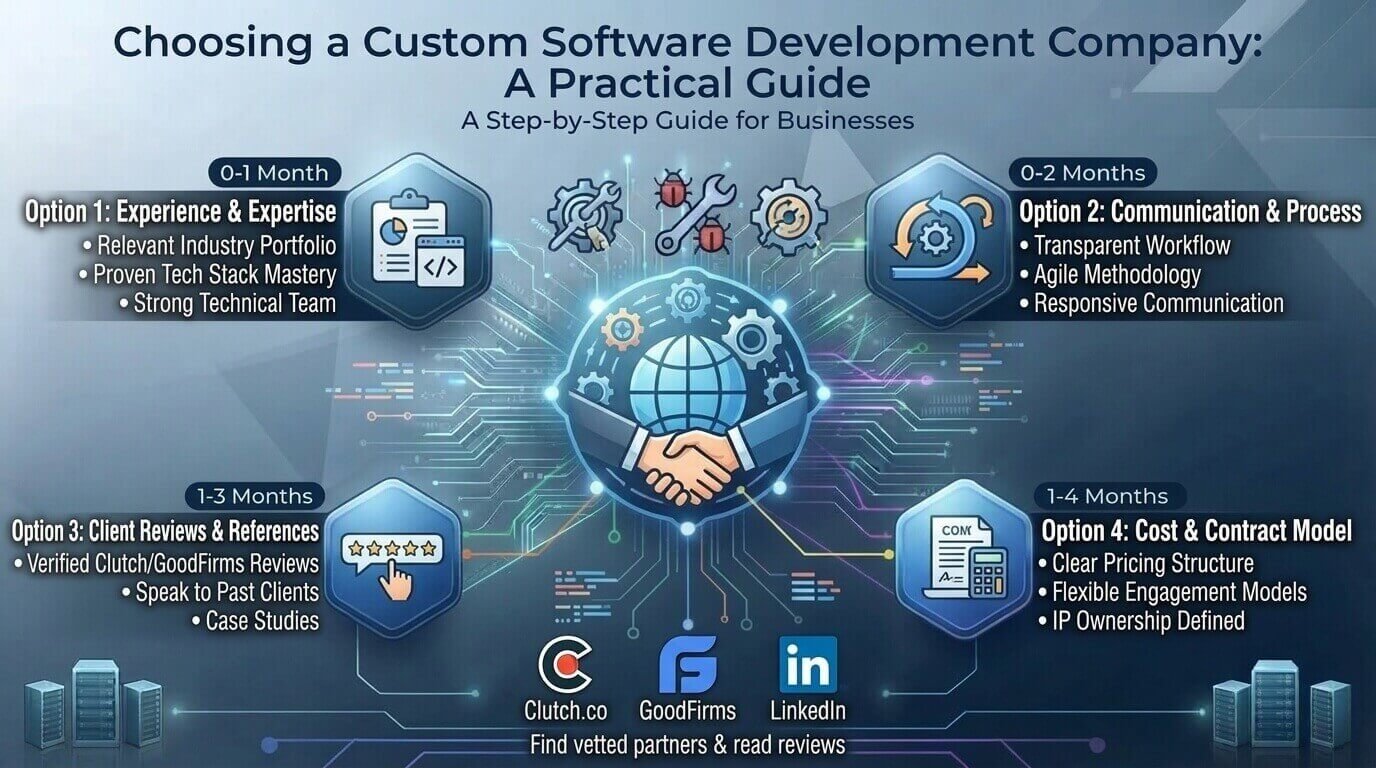
Choosing a custom software development company is a major business decision. The right development partner can turn a business problem into reliable software that saves time, improves workflows, and supports long-term growth. The wrong choice can lead to missed deadlines, unclear requirements, unexpected costs, security problems, and software that doesn’t solve the problem you started with.
So, how do you choose a custom software development company with confidence?
Don’t judge potential vendors by their portfolio or price alone. Look at their relevant experience, development team, technical approach, discovery process, security practices, communication, pricing, ownership terms, testing process, and post-launch support.
This guide explains what to evaluate, which questions to ask, how to compare proposals, and what to check before signing a software development contract.
First, Decide Whether You Actually Need Custom Software
Before comparing development companies, make sure custom development is the right solution.
Off-the-shelf software may already solve most of your requirements. Building a completely new application can cost considerably more and creates an ongoing responsibility for maintenance, security, hosting, and updates.
For example, a small business that needs basic project management may be better served by an established SaaS product. On the other hand, a manufacturer that needs software connecting production schedules, inventory, suppliers, customer orders, and accounting systems may have workflows that standard software cannot handle effectively.
For businesses dealing with stock, orders, warehouses, or multiple sales channels, it is worth first understanding what existing inventory management software can already provide. TechDigitalNet’s inventory management software guide
Ask these questions first:
- Can existing software solve most of the problem?
- Are your workflows genuinely different from standard processes?
- Do you need several systems to communicate through APIs or integrations?
- Do you need complete control over the application’s features and data?
- Could custom software provide a meaningful business advantage?
- Do you have the resources to maintain the software after launch?
You may also find that a hybrid solution makes more sense. Instead of building everything from scratch, you could use an existing platform and add custom integrations or modules.
The goal isn’t to build custom software simply because it’s possible. The goal is to solve the business problem in the most appropriate way.
What to Look for in a Custom Software Development Company
Once you’ve decided that custom development is appropriate, evaluate potential vendors systematically.
1. Look for Relevant Experience
Years in business are useful, but relevant experience matters more.
A company that has developed dozens of websites isn’t necessarily the right choice for a complex inventory platform, healthcare application, financial system, or enterprise integration project.
Look for experience with:
- Similar business models
- Similar workflows
- Comparable application complexity
- Similar integrations
- Similar security requirements
- Similar user volumes
Ask potential vendors:
- Have you built something similar?
- What challenges did you encounter?
- How did you solve them?
- Can you show a relevant case study?
- Can we speak with a previous client?
For example, if you’re building an inventory platform, a company that has previously connected warehouse management, purchasing, barcode scanning, and accounting systems may bring useful experience that a general-purpose development agency doesn’t have.
2. Examine Case Studies, Not Just Portfolio Screenshots
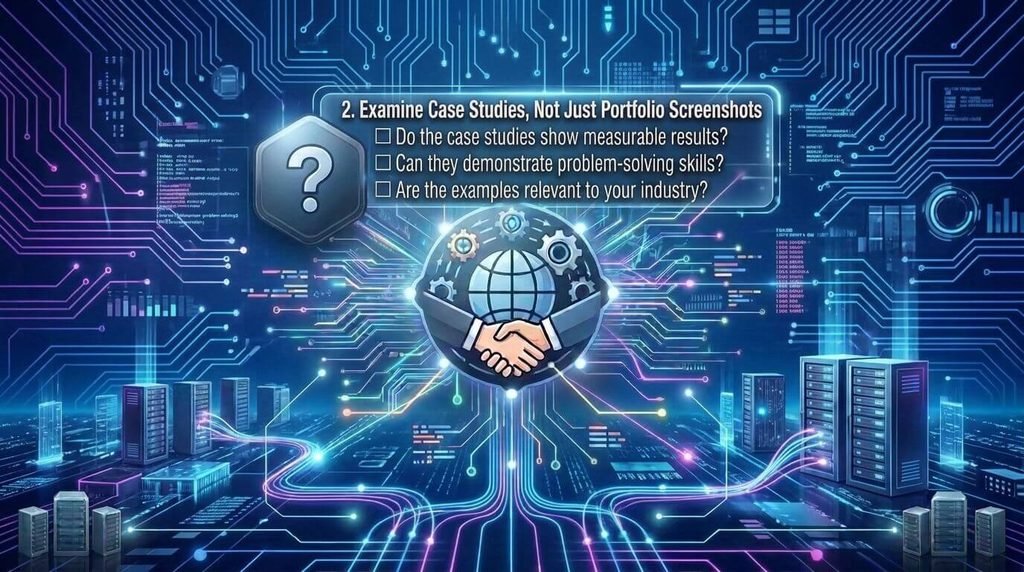
A portfolio tells you what a company has built. A detailed case study tells you how it solved a problem.
Look for case studies that explain:
- The client’s original problem
- Business requirements
- Technical challenges
- Development approach
- Technologies used
- Integrations
- Testing
- Results
Suppose an agency says it built an e-commerce platform. That’s useful, but it doesn’t tell you much by itself.
A stronger case study might explain that the client had thousands of products, multiple suppliers, inaccurate inventory data, and a manual order-processing workflow. The development team then integrated supplier data, automated inventory synchronization, and created an internal order-management dashboard.
That gives you evidence of problem-solving rather than just visual design.
3. Meet the People Who Will Actually Build the Software
One important question is often overlooked:
Who will actually work on the project?
The people involved in the sales process may not be the developers, architects, or QA specialists responsible for delivering the software.
Before signing, ask:
- Who is the technical lead?
- Who will manage the project?
- Who will develop the application?
- Who will handle QA?
- Who will manage deployment and infrastructure?
- Are developers employees or contractors?
- Can the assigned team change during the project?
If possible, speak with the technical lead before committing.
You don’t need to understand every technical detail. Pay attention to whether they can explain your requirements, risks, architecture, integrations, security considerations, and testing approach clearly.
4. Evaluate Technical Expertise and Architecture
Don’t choose a vendor simply because it lists many programming languages and frameworks on its website.
Ask why its proposed technology is appropriate for your project.
Depending on the application, relevant expertise may include:
- Front-end development
- Back-end development
- Database architecture
- API development
- Cloud infrastructure
- Mobile development
- DevOps
- Cybersecurity
- AI and machine learning
- Third-party integrations
For example, asking:
“Do you use React?”
is less useful than asking:
“Why would you recommend this technology for our application?”
A good technical discussion should also address scalability, performance, maintainability, security, integrations, and future development.
If your project will rely heavily on cloud infrastructure, you can also ask the development team how it plans to approach reliability, security, performance, and cost. The AWS Well-Architected Framework is a useful reference for evaluating these kinds of architectural considerations. AWS Well-Architected Framework
For additional background on how cloud technology can support modern applications and business operations, see TechDigitalNet’s guide to cloud computing essentials.
You aren’t necessarily looking for the company with the most sophisticated technology stack. You’re looking for a team that can make sensible technical decisions based on your actual requirements.
5. Pay Close Attention to the Discovery Process
A development company shouldn’t need to guess what your business needs.
Before development starts, the team should investigate:
- Business objectives
- Target users
- Current workflows
- Functional requirements
- Integrations
- Data requirements
- Security requirements
- Technical constraints
- MVP scope
- Risks and dependencies
The questions a company asks during discovery can reveal a lot about its approach.
Imagine you tell a vendor:
“We need software that automatically processes customer orders.”
A thoughtful team may ask:
- Where do orders currently originate?
- Which systems need the order information?
- How is inventory checked?
- What happens when a product is unavailable?
- Who approves unusual orders?
- What happens if an external API fails?
- Which information needs to be stored?
- What reports do managers need?
Those questions show an effort to understand the business workflow rather than simply turn a feature list into code.
What Should a Good Discovery Phase Produce?
Depending on the project, you may receive:
- Requirements documentation
- User flows
- Technical recommendations
- Architecture overview
- Wireframes or prototypes
- MVP scope
- Project estimates
- Risk assessment
- Development roadmap
The exact deliverables will vary, but you should finish discovery with a much clearer understanding of what you’re building and why.
6. Compare Development Processes
When learning how to choose a custom software development company, it’s important to understand how the vendor manages the development process. Software companies may use Agile, Scrum, Kanban, Waterfall, or hybrid approaches.
Don’t choose a vendor simply because it uses a particular methodology. Instead, find out how that methodology will affect your project.
Ask:
- How are requirements documented?
- How are milestones defined?
- How often will we review working software?
- How are changes handled?
- How are delays communicated?
- When can we test completed features?
- How is client feedback incorporated?
For example, if your requirements are likely to evolve as users interact with early versions of the product, a process with regular reviews and feedback may be useful.
If your requirements are highly defined and require extensive documentation, a more structured approach may be appropriate.
The development process should fit the project, its requirements, timeline, and business goals.
7. Compare the Total Cost, Not Just the Initial Quote
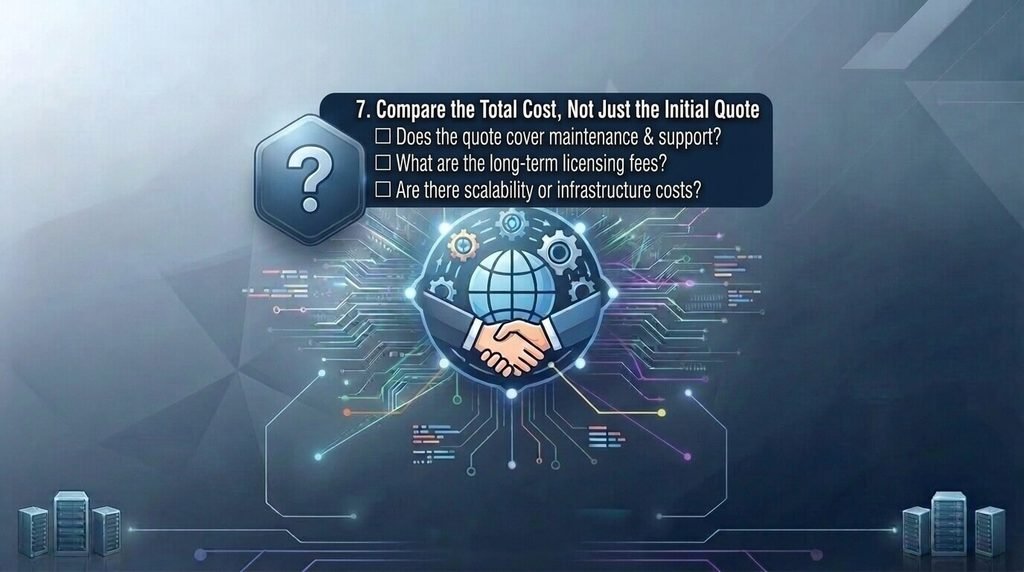
Price matters, but comparing only the headline number can be misleading.
One proposal might include:
- UI/UX design
- Development
- Testing
- Deployment
- Documentation
- Support
Another might quote a lower development price while charging separately for several of those services.
Potential project costs can include:
- Discovery
- UI/UX design
- Development
- Quality assurance
- Deployment
- Cloud hosting
- Third-party APIs
- Software licenses
- Security services
- Monitoring
- Maintenance
- Bug fixes
- Technical support
- Future feature development
For a broader look at how project complexity, features, developer experience, and hidden costs affect digital development budgets, see TechDigitalNet’s guide to website development cost.
Example: Comparing Two Proposals
Imagine you receive two quotes:
Company A: $40,000
Company B: $50,000
At first, Company A appears cheaper.
But suppose Company A excludes QA, deployment, documentation, and post-launch support, while Company B includes them.
The $10,000 difference doesn’t tell the whole story.
Compare the scope, assumptions, exclusions, payment schedule, and ongoing costs before deciding which proposal fits your requirements.
Also ask how additional requirements will be priced. A clear change-request process can prevent unpleasant surprises later.
8. Check Security Before Development Starts
Security shouldn’t be treated as a final feature added just before launch.
If your software handles customer information, financial data, employee records, healthcare information, or other sensitive data, discuss security during the planning stage.
Ask about:
- Authentication
- Authorization
- Access controls
- Data encryption
- Secure coding practices
- Vulnerability testing
- Dependency management
- Backups
- Incident response
- Production access
- Security updates
For example, if your application stores customer information in a cloud database, ask who can access that database, how credentials are protected, how backups work, and how unauthorized access would be detected.
The NIST Cybersecurity Framework 2.0 can also provide a useful reference when discussing how an organization identifies, assesses, prioritizes, and communicates cybersecurity risks. NIST Cybersecurity Framework 2.0
Microsoft’s guidance on a secure development lifecycle also emphasizes integrating security throughout development rather than waiting until the final stage. Microsoft secure development lifecycle guidance
Also determine who is responsible for security after launch. A development company may build secure software, but your organization may still have responsibilities involving accounts, infrastructure, permissions, and operational processes.
9. Clarify Source Code and Intellectual Property Ownership
This should be settled before development begins, not after the software is finished.
Your agreement should clearly address ownership or licensing of:
- Source code
- Database structures
- UI/UX designs
- Documentation
- Custom APIs
- Integrations
- Deployment configuration
- Other project-specific deliverables
Ask whether you will have access to the source-code repository.
Then ask an important question:
“If we stop working together next year, can another development company take over the project?”
This helps uncover potential vendor lock-in.
Imagine that your vendor owns the only copy of the source code and doesn’t provide repository access or documentation. Switching providers could become difficult, even if the original development contract has ended.
A good contract should make ownership, access, licensing, and handover responsibilities clear.
10. Evaluate Communication and Project Management
A technically strong development team can still create problems if communication is poor.
Before hiring a vendor, establish:
- Your primary point of contact
- Meeting frequency
- Progress-reporting process
- Project-management tools
- Documentation practices
- Decision-making process
- Escalation process
- Change-request process
For example, imagine you don’t see working software for six weeks. When the next demonstration arrives, you discover that an important feature was interpreted differently from what you intended.
Regular demonstrations could have exposed the misunderstanding much earlier.
Good communication doesn’t mean having meetings all day. It means having a reliable system for sharing progress, making decisions, documenting changes, and raising problems.
11. Examine Quality Assurance and Testing
Ask how the company will determine whether the software actually works as expected.
Depending on the project, testing may include:
- Functional testing
- Integration testing
- Regression testing
- Performance testing
- Security testing
- User acceptance testing
Ask:
- Who performs QA?
- Is testing included in the proposal?
- How are bugs documented?
- How are critical bugs prioritized?
- When can we test the software?
- What happens when problems are found after launch?
Consider an order-management system that works perfectly when one employee places an order but fails when 100 users access it simultaneously.
Basic functional testing might not uncover that problem.
The testing strategy should reflect how the software will actually be used.
12. Understand Post-Launch Support
Software isn’t finished simply because it has gone live.
You may need:
- Bug fixes
- Security updates
- Cloud or server maintenance
- Performance monitoring
- Database maintenance
- Backups
- New features
- Technical support
Ask what is included after launch and what costs extra.
For example, a vendor might provide 30 days of bug-fix support and then offer an optional monthly maintenance plan.
Another vendor might include a longer support period but charge separately for new features.
Neither model is automatically right or wrong. The important thing is understanding the terms before signing.
How to Verify a Software Development Company’s Claims
Marketing claims are not the same as evidence.
When a company makes an important claim, ask how you can verify it.
| Vendor claim | What to verify |
|---|---|
| “We have extensive experience.” | Relevant case studies and references |
| “Our developers are highly experienced.” | Meet the technical team |
| “We take security seriously.” | Security process and responsibilities |
| “We can finish quickly.” | Timeline assumptions and milestones |
| “Our price is competitive.” | Scope, exclusions, and total cost |
| “We provide excellent support.” | Written support terms or SLA |
| “We use AI to speed development.” | AI workflow, human review, testing, and data controls |
For example, if a company claims experience with large-scale applications, ask it to describe a previous scalability problem and how the team addressed it.
You don’t need to challenge every statement. The goal is to replace vague promises with useful evidence.
Questions to Ask Before Hiring a Custom Software Development Company
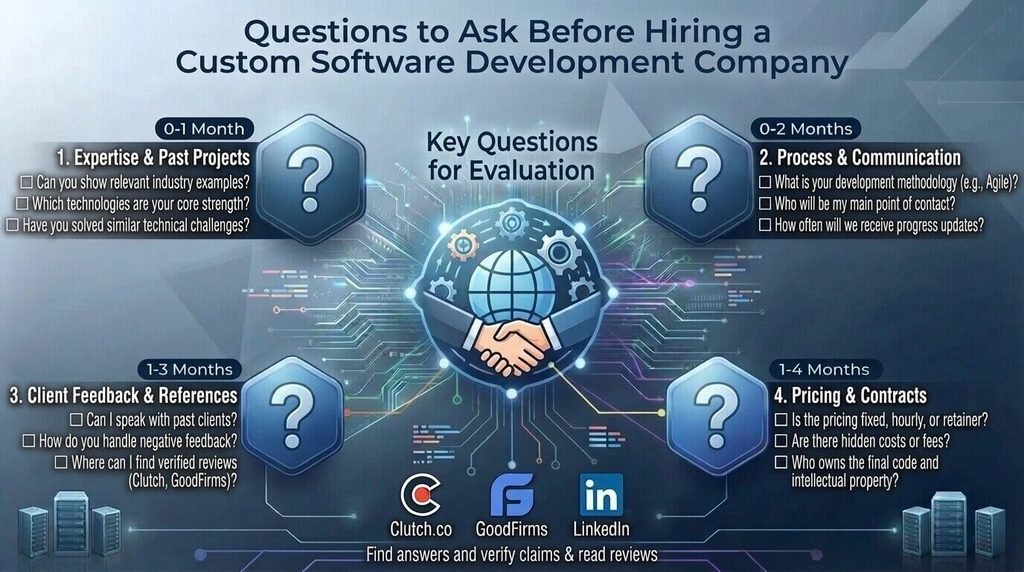
Use these questions when interviewing potential vendors.
Business and Experience
- Have you built software similar to ours?
- Can you show relevant case studies?
- Can we speak with a previous client?
- What assumptions are included in your proposal?
- What risks do you see in our project?
Technical
- What architecture would you recommend?
- Why is this technology stack appropriate?
- How will the application scale?
- How will integrations be handled?
- What are the biggest technical risks?
Project Management
- Who will manage the project?
- Who will actually develop it?
- How often will we receive progress updates?
- How will scope changes be handled?
- How will delays be communicated?
Financial
- What exactly is included?
- What is excluded?
- How are additional requirements priced?
- What payment milestones are proposed?
- What ongoing costs should we expect?
Ownership and Support
- Who owns the source code?
- Will we have repository access?
- Will we receive documentation?
- Can another developer take over the project?
- What support is available after launch?
The answers should be specific enough that you can compare one vendor’s proposal with another.
How to Compare Software Development Companies
Once you’ve shortlisted several vendors, use the same criteria for each one.
| Evaluation area | What to examine | Evidence |
|---|---|---|
| Relevant experience | Similar projects and industries | Case studies |
| Development team | People actually assigned to the project | Team information |
| Technical approach | Architecture and technology decisions | Technical discussion |
| Discovery | How requirements will be defined | Discovery plan |
| Security | Protection of systems and data | Security process |
| Pricing | Scope and total cost | Detailed proposal |
| QA | Testing strategy | QA plan |
| Ownership | Source code and deliverables | Contract |
| Support | Maintenance and post-launch service | Support terms |
| Communication | Updates and project management | Project plan |
This doesn’t mean every category deserves equal weight for every project.
For a simple internal tool, for example, advanced scalability may be less important than integration and usability.
For a customer-facing platform expected to serve thousands of users, architecture, performance, security, and scalability may require much more attention.
The evaluation criteria should reflect the actual project.
Consider a Discovery Phase or Small Pilot for Complex Projects.
For a large or uncertain project, you don’t necessarily have to jump straight into full development.
A staged approach might look like:
Discovery → Architecture → Prototype/Pilot → Development → Testing → Launch → Maintenance
A discovery or pilot engagement can give you an opportunity to evaluate:
- How well the team understands your requirements
- How clearly it communicates
- Whether technical assumptions are realistic
- How decisions are documented
- How the team responds to feedback
For example, instead of immediately committing to a long development engagement, a company could first commission requirements analysis, architecture planning, and a limited proof of concept.
This doesn’t eliminate project risk, but it can give you more information before making a larger commitment.
What to Ask About AI-Assisted Software Development in 2026
AI is becoming part of many software development workflows, so it’s reasonable to ask how a vendor uses it.
TechDigitalNet’s broader discussion of technology trends in 2026 also covers the growing role of AI-native development platforms and why faster code generation still requires appropriate human oversight. Technology Trends 2026
Don’t stop at:
“Do you use AI?”
Ask:
- Where will AI be used in the project?
- Who reviews AI-generated code?
- How is confidential client information protected?
- How is generated code tested?
- How are security risks reviewed?
- Does AI affect the estimated timeline?
- Does it affect the development cost?
- Which parts of the project require human review?
For example, a development team might use AI to assist with boilerplate code, documentation, testing, or code analysis while experienced developers remain responsible for architecture, review, security, and final implementation.
The important question isn’t whether a vendor uses AI. It’s whether the vendor has a clear process for maintaining quality, security, accountability, and control.
Custom Software Development Company Evaluation Checklist
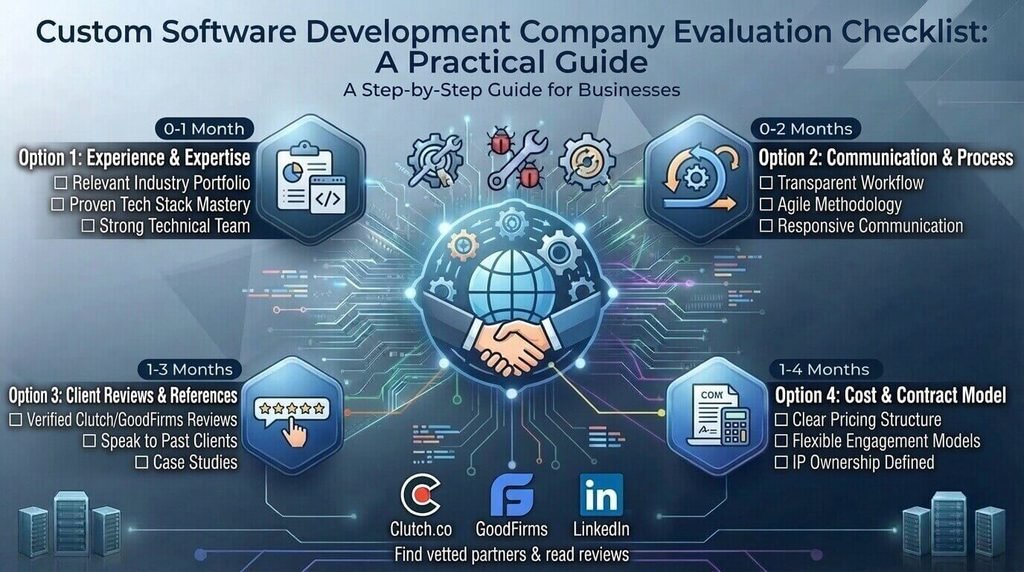
Before signing a contract, work through this checklist:
- ☐ Relevant experience has been verified
- ☐ Relevant case studies have been reviewed
- ☐ Client references have been checked
- ☐ The actual development team has been identified
- ☐ Technical recommendations have been explained
- ☐ Requirements have been documented
- ☐ MVP scope is clear
- ☐ Integrations and dependencies are identified
- ☐ Security requirements have been discussed
- ☐ Pricing and payment milestones are clear
- ☐ Included and excluded services are documented
- ☐ Source-code ownership is clear
- ☐ Repository access has been discussed
- ☐ QA and testing responsibilities are defined
- ☐ Change-request procedures are documented
- ☐ Launch responsibilities are clear
- ☐ Post-launch support terms are understood
- ☐ Handover and exit procedures are understood
If several important items remain unclear, get clarification before signing.
Final Checklist Before Signing the Contract
Before committing to a development company, make sure you understand:
- What will be built?
Features, integrations, platforms, and deliverables should be clearly defined. - What isn’t included?
Exclusions can be just as important as included services. - How will changes be handled?
Requirements can change, so the process and costs should be documented. - What will the project cost overall?
Consider development, infrastructure, third-party services, maintenance, and support. - Who will build the software?
Know the team, roles, and responsibilities. - How will quality be measured?
Establish testing and acceptance expectations. - Who owns the software?
Clarify source code, designs, documentation, and other deliverables. - What happens after launch?
Understand support, maintenance, security updates, and future development. - What happens if the relationship ends?
Make sure there is a practical handover process.
Frequently Asked Questions
How do I choose a custom software development company?
Start by defining your business requirements, then compare vendors based on relevant experience, technical expertise, development team, discovery process, security, pricing, communication, ownership, testing, and post-launch support. Ask for evidence rather than relying solely on marketing claims.
What should I ask a software development company before hiring?
Ask about relevant projects, the actual development team, technology choices, development methodology, pricing, security, source-code ownership, testing, communication, maintenance, and the process for transferring the project to another provider.
How much does custom software development cost?
There is no universal price. The cost depends on the application’s complexity, features, integrations, number of users, platforms, security requirements, team structure, and ongoing support. Compare the complete scope and total cost of each proposal rather than looking only at the initial quote.
How long does custom software development take?
The timeline depends on scope, complexity, integrations, team size, testing requirements, and changes during development. A small internal application may take considerably less time than a large platform involving multiple systems, user roles, and integrations.
Who owns custom software after development?
Ownership depends on the contract. The agreement should clearly state who owns or licenses the source code, designs, documentation, databases, integrations, and other project deliverables.
Should I choose a local or offshore software development company?
Either can work. Compare vendors based on technical expertise, relevant experience, communication, time-zone compatibility, project management, cost, security, availability, and long-term support rather than location alone.
Conclusion
Choosing a custom software development company is about more than finding a team that can write code.
You need a development partner that understands the business problem, asks useful questions, makes sensible technical decisions, communicates clearly, documents responsibilities, protects your data, and can support the software after launch.
Don’t choose based only on the lowest quote or the most impressive portfolio. Compare relevant experience, discovery, technical expertise, total cost, security, ownership, QA, communication, and support.
Most importantly, verify what you’re being told.
A strong case study is useful. A competitive proposal is useful. A persuasive sales presentation is useful. But the strongest evidence is a clear development process, an experienced team, realistic assumptions, transparent contractual terms, and a practical plan for delivering and maintaining the software.
Use the evaluation checklist in this guide to compare potential vendors systematically. That will give you a much stronger basis for choosing a development partner that fits your project’s actual requirements.