
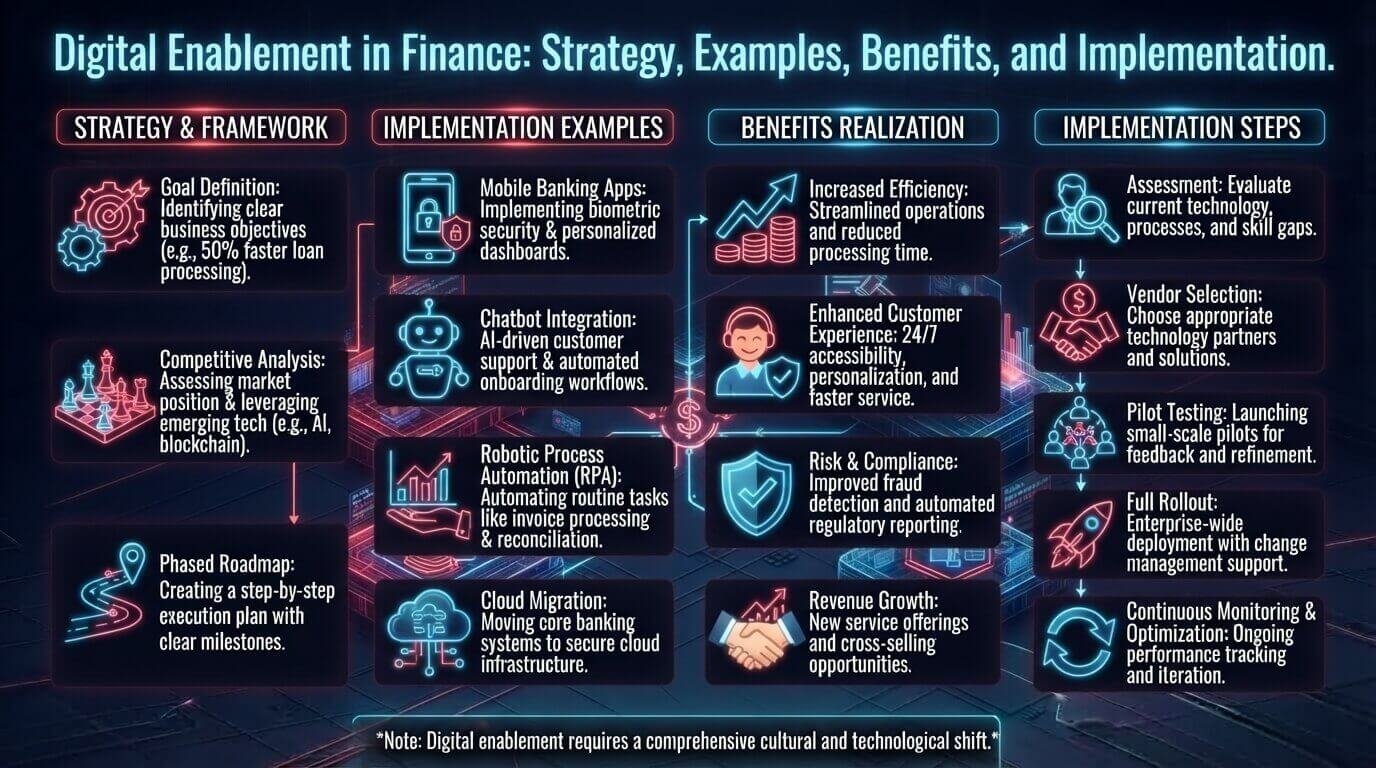
Finance departments are no longer expected to simply record transactions and prepare reports. Modern finance teams are increasingly responsible for providing real-time insights, improving forecasts, controlling costs, managing risk, and helping business leaders make better decisions.
That shift is driving interest in digital enablement in finance.
Digital enablement combines technology, data, automation, analytics, artificial intelligence, and redesigned workflows to make finance operations faster, more connected, and more useful to the wider business. The goal isn’t to automate people out of finance. It’s to remove unnecessary manual work so finance professionals can spend more time on analysis, planning, and decision-making.
For example, a finance employee who once spent hours downloading bank transactions and matching them with accounting records could instead review automatically matched transactions and investigate only exceptions.
This guide explains what digital enablement in finance means, how it differs from digital transformation and automation, where it delivers the most value, which technologies support it, how to implement it, and which KPIs can be used to measure success.
What Is Digital Enablement in Finance?
Digital enablement in finance is the use of digital technologies, connected data, automation, and modern workflows to improve financial operations and decision-making.
It involves more than purchasing accounting software. A genuinely digitally enabled finance function connects its people, processes, systems, and data.
Consider a traditional invoice process. An employee may receive an invoice by email, manually enter the details into an accounting system, send it for approval, check the payment status, and update a spreadsheet.
A digitally enabled process can capture invoice information automatically, match it with purchasing data, route it to the appropriate approver, record the transaction, and provide a real-time status.
The employee still plays an important role, particularly when something doesn’t match or requires judgment. The difference is that technology handles much of the repetitive work.
A simple way to think about digital finance
Traditional finance:
Manual data entry → Spreadsheets → Email approvals → Delayed reports → Reactive decisions
Digitally enabled finance:
Connected systems → Automated workflows → Centralized data → Real-time insights → Proactive decisions
The second model doesn’t eliminate the finance function. It gives finance professionals better tools to do higher-value work.
Digital Enablement vs. Digital Transformation vs. Finance Automation
These terms are closely related, but they aren’t identical.
| Approach | Main focus | Example |
|---|---|---|
| Finance automation | Automating specific repetitive tasks | Automatically matching invoices |
| Digital enablement | Improving finance capabilities with technology, data, people, and processes | Giving managers real-time financial dashboards |
| Digital transformation | Redesigning the broader finance operating model | Connecting ERP, procurement, banking, analytics, and workflows |
Finance automation is usually the most specific of the three. It targets individual activities.
Digital enablement takes a broader view. It asks how technology can improve the entire finance team’s ability to work, analyze information, collaborate, and make decisions.
Digital transformation can involve an even larger organizational change, including new operating models, systems, processes, roles, and customer experiences.
For example, automating invoice data entry is automation. Connecting procurement, accounts payable, approvals, payments, and reporting into a coordinated digital process is digital enablement. Redesigning the organization’s entire finance operating model around integrated digital systems is digital transformation.
Why Is Digital Enablement Important in Finance?
Finance teams handle information that affects almost every part of a business. When that information is delayed, fragmented, or difficult to analyze, management may struggle to respond quickly.
Digital enablement can address several common problems.
Reduce repetitive work
Finance professionals often spend time on recurring activities such as data entry, reconciliation, report preparation, invoice processing, and routine approvals.
Automating appropriate tasks allows employees to spend more time reviewing exceptions and interpreting financial information.
Improve data accuracy
Manual processes can introduce duplicate entries, calculation mistakes, missing information, and inconsistent records.
Automated validation and integrated systems can reduce some of these errors.
Speed up reporting
When information flows automatically between systems, finance teams don’t have to spend as much time collecting and formatting data before analysis can begin.
Improve financial forecasting
Connected financial and operational data can provide a stronger foundation for forecasting revenue, expenses, cash flow, and business performance.
Strengthen decision-making
A digitally enabled finance team can move beyond explaining what happened to helping management understand why it happened and what could happen next.
Improve visibility.
Dashboards and connected systems can give finance leaders a clearer view of important metrics without waiting for manually prepared reports.
Strengthen financial controls.
Digital approval workflows, permissions, audit trails, and automated checks can help organizations create more consistent control processes.
10 Practical Use Cases for Digital Enablement in Finance
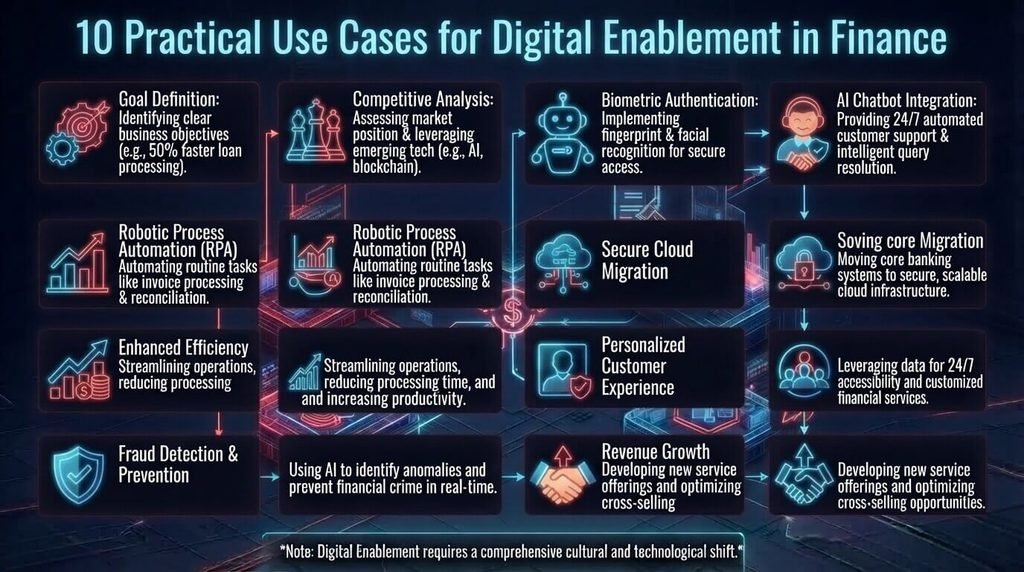
The best way to understand digital enablement is to look at where finance teams can actually use it.
1. Accounts Payable Automation
Accounts payable is often a strong candidate for automation because invoices follow relatively predictable processes.
Digital systems can capture invoice information, match invoices with purchase orders, route them for approval, and track payment status.
Example: A company receives hundreds of supplier invoices each month. Instead of manually entering every invoice, its system extracts the relevant information and sends mismatches to an employee for review.
Potential result: Faster invoice processing with less repetitive data entry.
2. Accounts Receivable Automation
Digital tools can automate invoice creation, payment reminders, collection workflows, and outstanding-balance monitoring.
For example, a business could automatically send payment reminders based on invoice due dates while giving the finance team a dashboard showing overdue accounts.
Potential result: Better visibility into receivables and more consistent collections.
3. Automated Bank Reconciliation
Bank reconciliation is another process where technology can save significant manual effort.
An integrated system can compare bank transactions with accounting records and identify transactions that don’t match.
Employees can then focus on exceptions rather than checking every transaction individually.
4. Financial Close Automation
Month-end close involves multiple activities, including reconciliations, journal entries, reviews, approvals, and documentation.
Digital close-management workflows can assign tasks, track completion, identify outstanding items, and maintain supporting documentation.
Example: Instead of using several spreadsheets to track which reconciliations have been completed, a finance manager can monitor the close process from a centralized workflow.
5. Cash-Flow Forecasting
Cash-flow visibility is particularly valuable for businesses that need to carefully manage working capital.
Finance teams can combine information about expected customer payments, supplier obligations, payroll, inventory, and other expenses to build more useful cash-flow forecasts.
This can help management identify potential cash shortages before they become urgent.
6. AI-Assisted Financial Forecasting
Artificial intelligence and machine learning can help analyze historical information and identify patterns that may support financial forecasting.
For example, a company might use predictive analytics to model several revenue scenarios based on historical sales, seasonality, customer behavior, and current business conditions.
AI-generated forecasts should still be reviewed by finance professionals. A model can identify patterns, but humans need to evaluate whether the assumptions make sense in the current business environment.
7. Fraud and Anomaly Detection
Digital systems can identify unusual transaction patterns and flag them for investigation.
Examples include:
- Duplicate payments
- Unusually large transactions
- Unexpected vendor changes
- Unusual transaction timing
- Activity outside established patterns
The system doesn’t need to determine that every flagged transaction is fraudulent. Its job can simply be to help finance professionals focus their attention where risk appears higher.
8. Real-Time Financial Dashboards
Financial dashboards can provide management with a centralized view of important information.
A CFO dashboard might include:
- Revenue
- Operating expenses
- Cash position
- Accounts receivable
- Accounts payable
- Profit margin
- Budget variance
- Forecast variance
A dashboard is only useful when the underlying data is accurate and relevant. A visually impressive dashboard built on unreliable data can create more confusion than clarity.
9. Digital Expense Management
Employees can submit expenses electronically, attach receipts, and send requests through predefined approval workflows.
Finance teams can use automated policy checks to identify expenses that require additional review.
This can reduce paperwork while improving visibility into spending.
10. Automated Financial Reporting
Instead of manually collecting information from multiple systems, organizations can integrate financial data into a reporting environment.
For example, information from accounting, payroll, sales, procurement, and inventory systems can be combined to provide a broader view of business performance.
This can reduce repetitive reporting work and give managers more time to analyze results.
Technologies That Power Digital Enablement in Finance
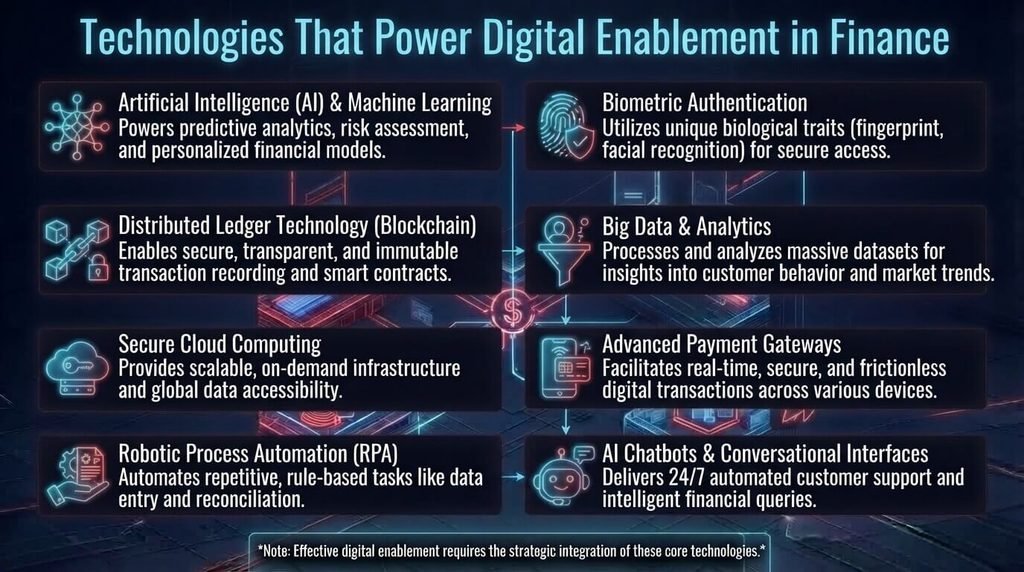
Digital enablement doesn’t depend on one technology. It usually involves several technologies working together.
Cloud Computing
Cloud-based financial applications can provide scalable access to financial systems and make it easier to connect distributed teams and applications.
Cloud technology can also support integrations, software updates, data access, and business continuity.
For readers who want to understand the technology behind modern digital operations, see our cloud computing essentials guide.
Artificial Intelligence and Machine Learning
AI can support:
- Forecasting
- Anomaly detection
- Document processing
- Pattern recognition
- Financial analysis
- Scenario planning
- Decision support
However, AI should be implemented with appropriate controls. Finance teams should know where AI is being used, what data it relies on, and when human review is required.
For organizations developing AI governance practices, the NIST AI Risk Management Framework is a useful authoritative resource.
Robotic Process Automation
Robotic process automation, or RPA, can handle repetitive, rules-based activities.
For example, an RPA workflow might move information between systems, generate recurring reports, or trigger notifications when a specific condition occurs.
RPA can be particularly useful when older systems cannot easily be integrated through modern APIs.
Business Intelligence
Business intelligence tools turn financial data into dashboards, reports, trends, and analytical views.
This helps finance teams move from manually producing reports toward interpreting what the information means.
APIs and System Integration
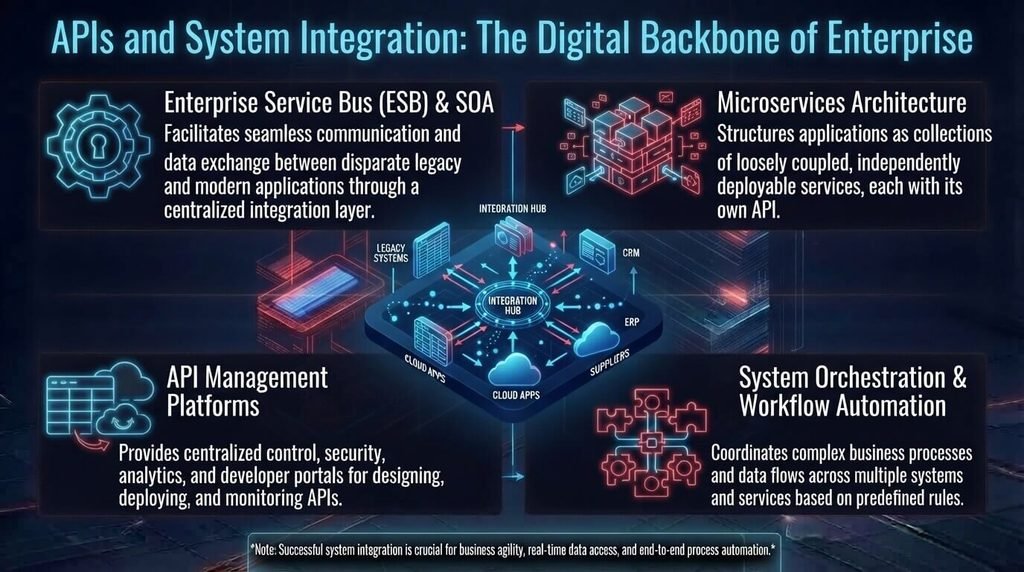
A typical finance department may use separate applications for accounting, banking, payroll, sales, purchasing, inventory, and customer management.
APIs can help these systems exchange information.
Integration is important because simply adding more applications can create more data silos.
Data Platforms
Data warehouses and other centralized data environments can bring information from different systems together.
This creates a stronger foundation for reporting, analytics, forecasting, and AI.
How to Implement Digital Enablement in Finance
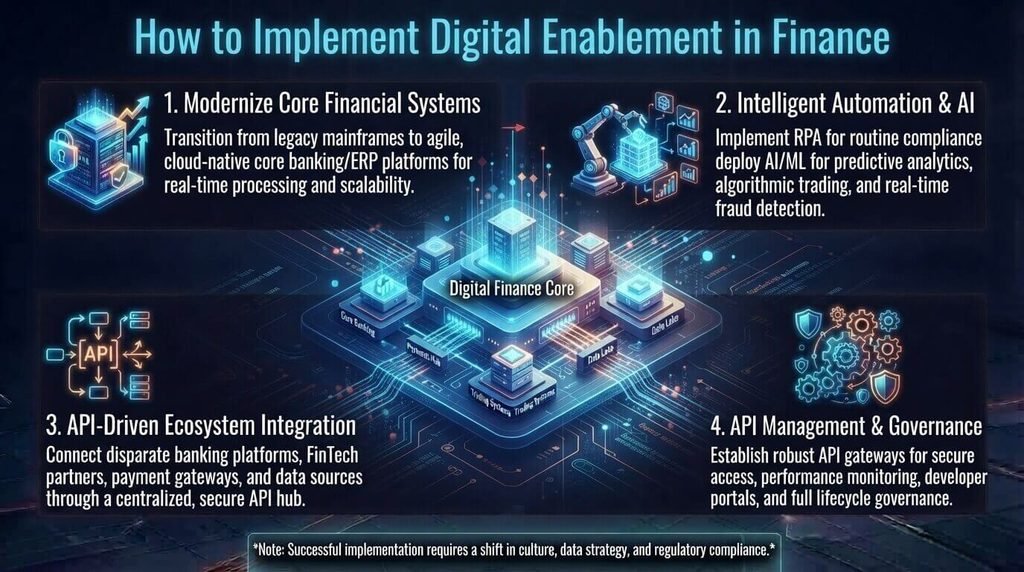
Technology should follow the business problem—not the other way around.
A practical implementation process can be divided into eight steps.
Step 1: Assess Current Finance Processes
Start by documenting how important finance processes work today.
Look for:
- Manual data entry
- Spreadsheet dependencies
- Duplicate work
- Slow approvals
- Reporting delays
- Reconciliation problems
- Frequent errors
- Disconnected systems
Don’t assume every process needs automation. Some processes may be inefficient because of poor design rather than a lack of technology.
Step 2: Prioritize High-Value Opportunities
Rank potential projects according to factors such as:
- Business impact
- Transaction volume
- Time consumed
- Error frequency
- Automation potential
- Implementation complexity
A process that consumes several employee hours every week may offer a clearer starting point than a process performed once each quarter.
Step 3: Improve Data Quality
Before implementing advanced analytics or AI, examine the quality of your data.
Check for:
- Duplicate records
- Missing information
- Inconsistent formats
- Outdated data
- Unclear data ownership
- Incorrect classifications
Automating poor-quality data doesn’t solve the underlying problem. It can simply make the problem happen faster.
Step 4: Choose Technology Based on Requirements
Instead of asking, “Which finance software should we buy?” start with:
What problem are we trying to solve?
A small company may need cloud accounting and automated invoicing. A larger organization may require ERP integration, business intelligence, RPA, data platforms, and AI.
Technology selection should reflect business needs, budget, existing systems, security requirements, and future growth.
If your business also manages stock and purchasing workflows, related inventory management software resources can help connect finance processes with inventory operations.
Step 5: Integrate Important Systems
Avoid creating isolated digital tools.
For example, an invoice-processing application that doesn’t communicate with procurement or accounting may still require significant manual work.
Integration should be considered early in the implementation process.
Step 6: Train Finance Employees
Employees need to understand both the technology and the reason behind the change.
Training should cover:
- New workflows
- Software usage
- Exception handling
- Data security
- AI limitations
- New responsibilities
The goal is to help employees become more capable with technology—not simply tell them to use another application.
Step 7: Start With a Pilot
Choose one process with a clear problem and measurable outcome.
For example, a company could begin by automating accounts payable.
Establish the current processing time and error rate, implement the new workflow, and compare the results.
If the pilot works, expand the approach to other processes.
Step 8: Measure and Improve
Digital enablement shouldn’t end when the software goes live.
Review performance regularly and ask:
- Did processing time decrease?
- Did errors decrease?
- Are employees adopting the system?
- Did operating costs change?
- Did reporting become faster?
- Are managers receiving better information?
Use the answers to improve the next phase of the program.
Digital Finance Maturity Model
A maturity model helps organizations understand that digital enablement is a journey rather than a single project.
Level 1: Manual Finance
Characteristics include:
- Heavy spreadsheet use
- Paper documents
- Manual approvals
- Manual reconciliation
- Disconnected systems
Level 2: Basic Digital Finance
The organization begins using:
- Cloud accounting
- Electronic documents
- Digital approvals
- Basic reporting
Level 3: Connected Finance
Systems become integrated.
Typical capabilities include:
- ERP integration
- Automated workflows
- Centralized data
- Automated reporting
- Digital controls
Level 4: Intelligent Finance
The organization adds:
- Predictive analytics
- AI
- Machine learning
- Automated anomaly detection
- Advanced forecasting
Level 5: Strategic Digital Finance
At this stage, finance operates with highly connected data, continuous forecasting, intelligent automation, and real-time decision support.
Even at this level, human expertise remains essential for complex decisions, exceptions, and high-risk financial activities.
How to Measure Digital Enablement in Finance
Technology adoption alone doesn’t prove that a finance transformation is successful.
You need measurable outcomes.
| KPI | What it tells you |
|---|---|
| Financial close time | How quickly the books are closed |
| Invoice processing time | Efficiency of accounts payable |
| Cost per transaction | Cost of processing finance activities |
| Forecast accuracy | Quality of financial planning |
| Reconciliation cycle time | Efficiency of reconciliation |
| Manual journal entries | Degree of automation |
| Error rate | Process and data quality |
| Employee adoption rate | Whether employees are using the system |
| Digital process percentage | How much finance work is digitally enabled |
| ROI | Financial return from the initiative |
The best KPIs depend on the objective.
If the goal is faster invoice processing, measure invoice cycle time. If the goal is better forecasting, measure forecast accuracy. If the goal is lower operating costs, measure cost per transaction.
How to Calculate the ROI of Digital Enablement
Finance leaders need a clear business case before investing in major technology initiatives.
A simple ROI formula is:
ROI = (Financial Benefits − Investment Cost) ÷ Investment Cost × 100
For example, imagine a company invests $50,000 in a finance automation project and estimates $80,000 in measurable first-year benefits.
The calculation is:
($80,000 − $50,000) ÷ $50,000 × 100 = 60% ROI
The actual calculation can be more complicated because not every benefit is immediately visible as a cost saving.
Potential benefits include:
- Reduced processing hours
- Lower administrative costs
- Fewer errors
- Faster financial close
- Better cash management
- Reduced fraud exposure
- Faster reporting
- Improved forecasting
A useful business case should also consider implementation costs, software subscriptions, integration, training, maintenance, and ongoing support.
Common Challenges of Digital Enablement in Finance
Digital finance projects can fail even when the technology itself works.
Poor Data Quality
Unreliable data can produce unreliable reports, forecasts, and automated decisions.
Legacy Systems
Older applications may not integrate easily with modern financial platforms.
Employee Resistance
Employees may resist new workflows when they don’t understand the purpose of the change or worry that automation will make their roles less important.
Cybersecurity Risks
Finance systems contain sensitive information, so access controls, authentication, encryption, monitoring, and security policies are critical.
Implementation Costs
Software is only one part of the investment. Organizations may also need to pay for integration, migration, training, consulting, security, and ongoing support.
Lack of Leadership Alignment
Digital finance initiatives need clear ownership and support from business leadership.
Too Many Tools
More software doesn’t automatically mean better finance operations.
Five well-integrated systems can be more effective than ten disconnected applications.
Security and AI Governance in Digital Finance
Finance teams should treat security as part of digital enablement from the beginning.
Important controls can include:
- Role-based access
- Multi-factor authentication
- Encryption
- Audit trails
- Access reviews
- Data privacy controls
- Vendor security assessments
- Backup and recovery procedures
- AI governance
- Human review of high-risk outputs
Organizations can also use the NIST Cybersecurity Framework as a recognized reference when developing or improving cybersecurity risk-management practices.
AI deserves particular attention.
Suppose an AI system produces a financial forecast. The finance team should understand what information influenced that forecast and have a process for reviewing unusual or questionable results.
The goal should be responsible automation.
Automate repetitive work, augment human expertise, and retain human oversight where financial judgment or risk is significant.
Digital Enablement for Small, Mid-Sized, and Enterprise Finance Teams
The right digital finance strategy depends on the size and complexity of the organization.
Small businesses
A small company might begin with:
- Cloud accounting
- Automated invoicing
- Digital payments
- Expense management
- Basic financial dashboards
The priority should be affordable tools that solve immediate problems.
Mid-sized businesses
As complexity increases, organizations may consider:
- ERP integration
- Business intelligence
- Automated workflows
- Financial forecasting
- Advanced reporting
- Expense automation
Enterprises
Large organizations may need:
- Enterprise data platforms
- AI
- RPA
- Advanced analytics
- APIs
- ERP integration
- Data governance
- Enterprise security controls
The goal isn’t to adopt every available technology. It’s to create a finance function that is connected, efficient, secure, and capable of supporting better decisions.
What Should Finance Teams Automate First?
If your organization is just beginning its digital finance journey, start with processes that are:
- High volume
- Repetitive
- Rules-based
- Time-consuming
- Error-prone
- Easy to measure
Accounts payable, expense processing, reconciliation, recurring reporting, and routine data transfers are often good starting points.
Be more cautious with processes involving complex judgment, unusual transactions, sensitive decisions, or significant regulatory consequences.
A strong first project has three characteristics:
A clear problem + a repeatable process + a measurable outcome.
The Future of Digital Enablement in Finance
Finance technology will continue moving toward greater connectivity, automation, real-time analytics, and AI-assisted decision-making.
Generative AI may help finance professionals analyze information, summarize reports, interact with financial data using natural language, and accelerate routine knowledge work.
Predictive analytics can support forecasting, while intelligent automation can handle increasingly sophisticated workflows.
But the future isn’t simply about replacing finance professionals with machines.
Financial decisions often require context, business knowledge, professional judgment, and an understanding of unusual circumstances.
The strongest finance teams will likely combine automation with human expertise.
Technology can process information quickly. People provide context, challenge assumptions, investigate exceptions, and decide what the numbers actually mean for the business.
Frequently Asked Questions About Digital Enablement in Finance
What is digital enablement in finance?
Digital enablement in finance is the use of digital technology, automation, connected data, analytics, and modern workflows to improve financial operations and decision-making.
What are examples of digital enablement in finance?
Examples include accounts payable automation, automated reconciliation, digital expense management, financial dashboards, AI-assisted forecasting, anomaly detection, automated reporting, and integrated financial systems.
What technologies are used in digital finance?
Common technologies include cloud computing, artificial intelligence, machine learning, robotic process automation, business intelligence, APIs, ERP systems, data platforms, and workflow automation.
How does digital enablement improve finance operations?
It can reduce repetitive work, improve data visibility, speed up reporting, support forecasting, strengthen certain financial controls, and give finance professionals more time for analysis.
What is the difference between digital transformation and digital enablement?
Digital enablement focuses on improving finance capabilities through technology, data, processes, and people. Digital transformation is broader and may involve redesigning the organization’s entire operating model.
How can a finance team start digital transformation?
Start by identifying inefficient processes, prioritizing high-value opportunities, improving data quality, selecting suitable technology, integrating systems, training employees, testing a pilot, and measuring results.
How do you measure digital enablement in finance?
Useful measurements include financial close time, invoice processing time, forecast accuracy, reconciliation cycle time, error rates, automation percentage, employee adoption, processing costs, and ROI.
What are the biggest challenges of digital finance transformation?
Common challenges include poor data quality, legacy systems, employee resistance, cybersecurity risks, integration problems, implementation costs, insufficient training, and weak strategic alignment.
Final Takeaway
Digital enablement in finance isn’t about buying the newest software or automating every task.
It’s about using technology where it genuinely improves the way finance teams work.
Start with a real business problem. Clean up the data behind it. Automate repetitive activities. Connect important systems. Train employees. Protect financial information. Then measure whether the change actually improved performance.
The most effective digital finance strategy is the one that produces measurable improvements while giving finance professionals better information and more time to make decisions.
In simple terms:
Use technology to handle repetitive work so people can focus on the financial decisions that technology alone cannot make.