
If you’re planning to build a mobile app in the UK, one of the first questions you’ll probably ask is: how much does app development cost in the UK?
The honest answer is that there is no single price.
A tightly scoped MVP may cost around £10,000–£30,000, while a standard business app can fall around £30,000–£80,000. More complex marketplaces, SaaS products, fintech applications and enterprise platforms can move beyond £100,000 and into the £150,000–£300,000+ range.
These are planning ranges rather than fixed quotations. The actual cost depends on what you want the application to do, how many platforms you support, how complex the backend is, which integrations are required and who builds it.
This guide explains app development cost UK businesses should expect in 2026, what affects the price, what different budgets can realistically buy, ongoing costs, and how to compare development quotes before making a decision.
How Much Does App Development Cost in the UK?
As a practical starting point, you can use these ranges when planning your budget:
| App type | Typical planning budget | Approximate timeline |
|---|---|---|
| Simple MVP | £10,000–£30,000 | 2–3 months |
| Standard business app | £30,000–£80,000 | 3–6 months |
| Complex application | £80,000–£150,000+ | 6–12+ months |
| Enterprise or highly regulated platform | £150,000–£300,000+ | 9–18+ months |
These figures should be treated as planning estimates, not guaranteed UK market prices.
A basic booking app and a nationwide marketplace may both be described as “mobile apps”, but their technical requirements are completely different.
For example, a simple app might only require:
- User registration
- A few screens
- Basic database functionality
- Notifications
- One core workflow
A more advanced application might need:
- Multiple user roles
- Payments
- Real-time communication
- GPS
- Advanced search
- An admin dashboard
- Third-party APIs
- AI features
- Cloud infrastructure
- Complex security
That difference is why one business may receive a £20,000 quotation while another receives a £100,000+ proposal.
A Quick Way to Estimate Your App Budget
Before contacting developers, answer these questions:
- Who will use the app?
- How many types of users will there be?
- Do you need iOS, Android or both?
- Will users create accounts?
- Will you accept payments?
- Do you need an admin dashboard?
- Will the app use GPS or maps?
- Do users need chat or messaging?
- Will the app connect to external APIs?
- Will you use AI?
- Will the app process sensitive information?
- Do you need real-time functionality?
The more complex your answers are, the more development effort you’re likely to need.
If you are new to software development, it can also help to understand the basics of what coding is and how it works before discussing technical requirements with a developer.
What Does an App Development Budget Actually Pay For?
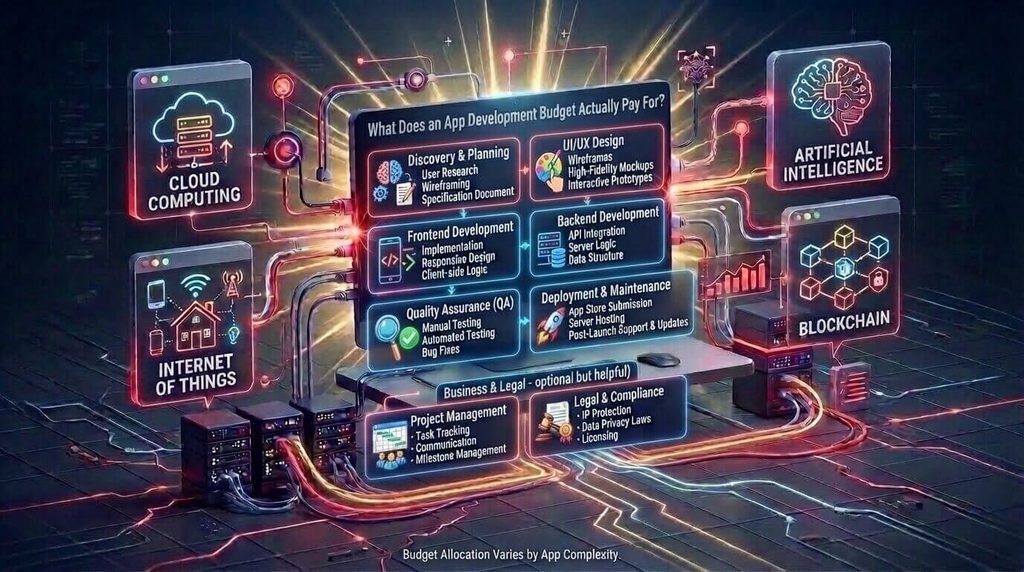
The mobile interface is only one part of a modern application.
A professional project can involve:
- Product discovery
- Requirements planning
- UX/UI design
- Frontend development
- Backend development
- Database architecture
- API integrations
- Authentication
- Payment processing
- Testing
- Security
- Cloud infrastructure
- Analytics
- App-store deployment
- Maintenance
This is why the number of screens alone is not a reliable way to estimate mobile app development cost in the UK.
A ten-screen application with payments, maps, real-time data and multiple user roles could require much more work than a twenty-screen informational app.
1. Discovery and Requirements
Before development begins, the team needs to understand exactly what the application should accomplish.
The discovery stage can include:
- Business requirements
- User research
- Competitor analysis
- User journeys
- Feature prioritisation
- Technical planning
- Product specifications
This stage may seem like an extra expense, but it can prevent much more expensive mistakes later.
If developers begin building without a clear understanding of the product, changes can lead to delays, additional development hours and budget increases.
2. UX and UI Design
Good app design involves much more than selecting colours and creating attractive screens.
A professional UX/UI process may include:
- Wireframes
- User flows
- Interactive prototypes
- Interface design
- Design systems
- Accessibility
- Error states
- Loading states
- Navigation
- Responsive layouts
A simple internal application may require relatively little design work.
A consumer application competing with established brands may require considerably more research, testing and visual refinement.
3. Frontend Development
The frontend is the part of the application users interact with.
It includes:
- Screens
- Navigation
- Forms
- Buttons
- Animations
- User interactions
- Device features
- Data presentation
The complexity of these features matters more than the raw number of screens.
For example, a basic profile screen might be relatively straightforward.
A dashboard containing live charts, filters, maps, notifications and real-time information is much more complicated.
4. Backend Development
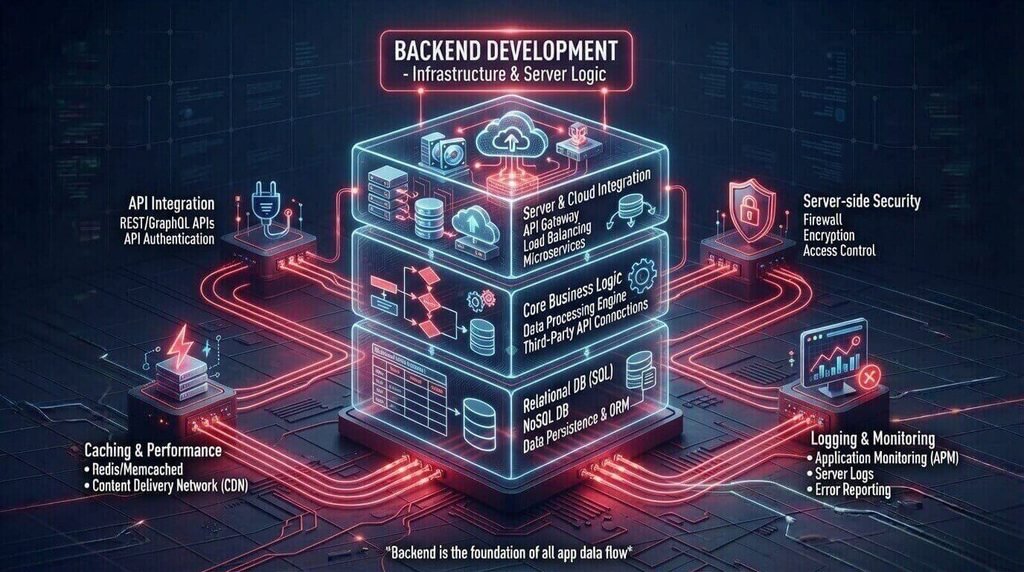
The backend is where much of the application’s hidden complexity exists.
An e-commerce application may need to manage:
- Customers
- Products
- Orders
- Payments
- Stock
- Discounts
- Refunds
- Notifications
- Permissions
A simple app may only require a small backend.
A marketplace, SaaS platform or financial application can require a much more sophisticated architecture.
If you’re interested in understanding how applications work beyond their visible interface, our guide to web app development provides useful background on application architecture and development.
5. Testing and Quality Assurance
Testing should be part of your original development budget.
Depending on the project, developers may need to test:
- Different smartphones
- Screen sizes
- Operating-system versions
- Slow internet connections
- Login and registration
- Payments
- Notifications
- API failures
- Permissions
- Security
- Performance
Testing becomes especially important when an application handles payments, personal information or other sensitive data.
A cheaper project that launches with serious bugs can become more expensive after launch because fixing problems in production may require emergency development work.
App Development Cost by Complexity
Simple MVP: Around £10,000–£30,000
An MVP, or minimum viable product, should solve one important customer problem without trying to include every feature on your long-term roadmap.
For example, a cleaning-service MVP might include:
- Customer registration
- Service selection
- Booking
- Basic payment functionality
- Booking history
- Push notifications
The objective is to launch something useful, collect feedback and learn what customers actually need.
If you add live cleaner tracking, in-app messaging, complex scheduling, multiple provider accounts and advanced administration, the project can quickly move into a higher budget.
Standard Business App: Around £30,000–£80,000
A more established business application might include:
- Multiple user roles
- Profiles
- Payments
- Notifications
- Analytics
- APIs
- Cloud backend
- Admin dashboard
- More advanced workflows
For example, a property-management application might allow landlords to manage properties while tenants submit maintenance requests, upload images, receive notifications and communicate with property managers.
The complexity comes from connecting users, permissions, data and business rules.
Complex Application: £80,000–£150,000+
Complex applications can include:
- Marketplaces
- Fintech platforms
- Healthcare applications
- Logistics systems
- Large booking platforms
- Social networks
- Enterprise workforce systems
- Multi-tenant SaaS products
These projects can involve several user types, complex security requirements, extensive integrations and sophisticated backend architecture.
Enterprise and highly regulated projects can move well beyond £150,000 depending on scope.
How Much Does Each App Feature Add to the Cost?
There is no universal price for an individual feature because implementation can vary significantly.
However, this table helps illustrate the relative complexity:
| Feature | Typical complexity |
|---|---|
| Email login | Low |
| Social login | Low–Medium |
| User profiles | Low–Medium |
| Push notifications | Low–Medium |
| Maps/GPS | Medium |
| Payments | Medium |
| Booking system | Medium–High |
| Advanced search | Medium–High |
| Chat | Medium–High |
| AI functionality | Medium–High |
| Real-time tracking | High |
| Video calling | High |
| Marketplace | High–Very High |
| Advanced admin dashboard | High |
Why “simple” features can become expensive
Consider chat.
A basic one-to-one text messaging system is very different from a platform that supports:
- Group conversations
- Images and videos
- Read receipts
- Typing indicators
- Push notifications
- Message search
- Moderation
- Blocking
- Reporting
- Message history
Payments work in a similar way.
“Add payments” could mean a simple checkout, or it could involve:
- Subscriptions
- Refunds
- Failed payments
- Invoices
- Multiple currencies
- Payment status
- Financial reporting
The feature name does not determine the cost.
The implementation behind the feature does.
iOS vs Android vs Cross-Platform: Which Is Cheaper?
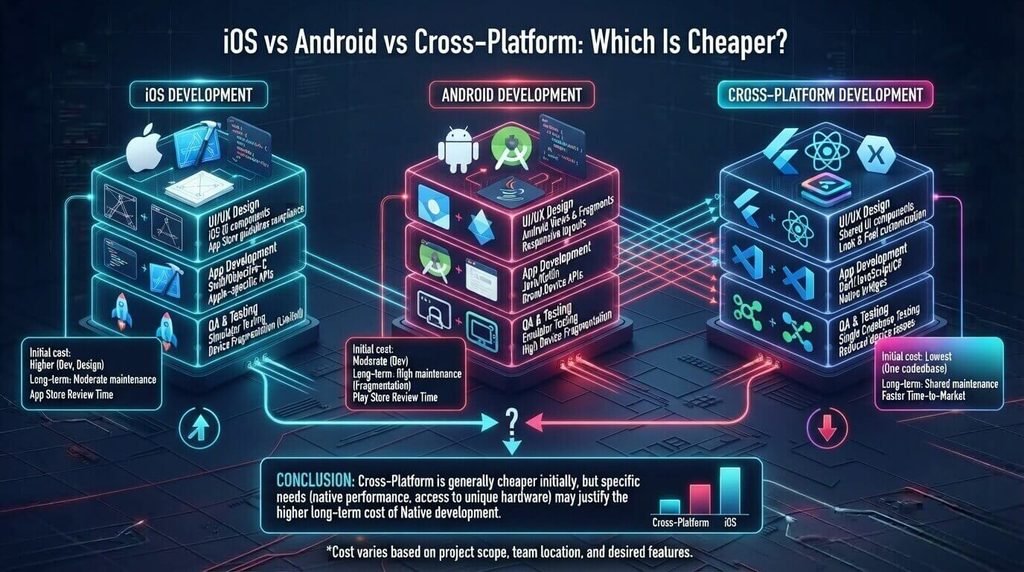
Your platform strategy can have a significant impact on your overall development budget.
Native iOS
Native iOS development is built specifically for Apple’s ecosystem.
It may make sense when:
- Your target audience is primarily iPhone users
- You need deep Apple integrations
- Performance is especially important
- You require platform-specific functionality
When you’re ready to publish an iOS app, Apple’s official App Store Connect documentation explains the submission, testing, pricing and management process.
Native Android
Android provides access to a broad range of devices.
However, device diversity can increase testing requirements because hardware, screen sizes and operating-system versions vary.
Cross-Platform Development
Frameworks such as Flutter and React Native allow developers to share significant portions of code between platforms.
Flutter’s official documentation describes it as a framework for building multiplatform applications from a single codebase.
You can explore the official Flutter documentation when evaluating this approach.
React Native is another widely used option for creating native applications for Android and iOS using React and JavaScript.
The official React Native documentation provides more information about the framework.
Cross-platform development can reduce duplicated work, but it does not mean the total project automatically costs half as much.
You still need:
- Backend development
- Testing
- Platform-specific functionality
- App-store preparation
- Device compatibility
- Native integrations
- Ongoing maintenance
How Much Do UK App Developers Charge?
The project price is generally connected to the amount of work required and the rates charged by the development team.
A simple way to understand the calculation is:
Estimated development cost = estimated effort × applicable rate
For example:
100 development days × £500/day = £50,000
That is only an illustration, not a guaranteed UK development rate.
The final project may also involve:
- UX/UI designers
- Developers
- QA specialists
- Project managers
- DevOps engineers
- Security specialists
This is one reason agency quotations can be considerably higher than the rate of an individual freelancer.
Freelancer vs UK App Development Agency
Freelancer
A freelancer may be suitable for:
- Small apps
- MVPs
- Prototypes
- Clearly defined projects
The main advantage is often lower overhead.
The downside is that one person may not have deep expertise in every area your project requires.
UK Agency
An agency can provide access to a broader team, such as:
- Product managers
- UX/UI designers
- Developers
- QA specialists
- DevOps engineers
- Security specialists
This can increase the project price, but it may also reduce the risk of coordinating several specialists yourself.
Offshore Development Team
Offshore development may offer lower labour costs, but price should not be your only consideration.
Compare:
- Communication
- Time zones
- Project management
- Code quality
- Security
- Intellectual-property ownership
- Documentation
- Support
- Long-term maintenance
A lower initial quotation is not necessarily cheaper over the life of the application.
In-House Development Team
Building your own team gives you more control, but the cost includes more than salaries.
You may also need:
- Recruitment
- Benefits
- Equipment
- Software
- Management
- Training
- Office costs
For many businesses launching their first application, an external development team may be more practical.
What Makes App Development More Expensive?
Several factors consistently increase development complexity.
More Platforms
Supporting both iOS and Android can require additional development and testing compared with launching on one platform.
More User Types
A customer-only application is generally simpler than a marketplace with:
- Customers
- Sellers
- Delivery workers
- Administrators
Each role can require different permissions, screens and workflows.
Complex Backend Requirements
The more data, permissions and business rules your application handles, the more backend work may be required.
Third-Party Integrations
Connecting payment providers, maps, CRM systems, accounting software or external databases introduces additional development and testing requirements.
Real-Time Functionality
Live tracking, messaging, availability indicators and real-time dashboards require infrastructure capable of handling continuously changing information.
Security and Privacy
Applications processing personal or sensitive information may require additional security and privacy work.
For UK businesses, privacy requirements should be considered during product design rather than added at the last minute. The ICO provides guidance on data protection and storage/access technologies for organisations developing digital products.
You can review the official ICO guidance when planning privacy requirements.
Custom Design
A highly customised interface with advanced animations and interactions generally requires more design and development effort than a straightforward interface.
Artificial Intelligence
AI can increase development costs depending on how it is implemented.
For example, there is a major difference between:
- Connecting an app to an existing AI API
- Building an AI recommendation system
- Training custom models
- Processing large datasets
- Building complex AI infrastructure
AI can also reduce development time for certain tasks, but it does not remove the need for architecture, testing, security and experienced engineering.
For broader technology context, you can also explore Technology Trends 2026 on TechDigitalNet.
What Are the Hidden Costs of Building an App?
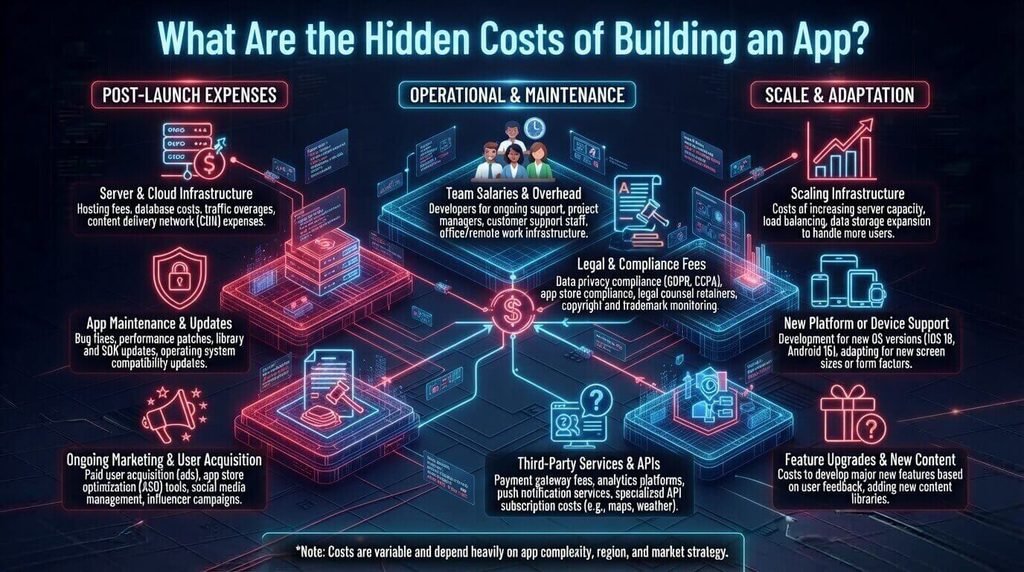
The development quotation is not necessarily your complete first-year budget.
You may also need to pay for:
- App-store accounts
- Cloud hosting
- Databases
- API usage
- Payment processing
- Analytics
- Monitoring
- Security tools
- Email services
- SMS services
- Customer support
- Maintenance
- Marketing
- Legal and compliance work
App-store costs can also depend on your business model.
For example, Apple’s official documentation explains that app pricing, availability, commissions and applicable taxes can vary according to the developer’s setup and business model.
You can check the latest requirements directly through Apple’s App Store Connect documentation before budgeting for iOS distribution.
How Much Does It Cost to Maintain an App in the UK?
Launching the application is only the beginning.
Ongoing costs may include:
- Bug fixes
- Security updates
- Operating-system compatibility
- Cloud infrastructure
- API usage
- Monitoring
- Analytics
- Customer support
- Performance improvements
- New features
Some industry estimates use a percentage of the original development cost as a maintenance planning benchmark, but there is no universal maintenance percentage.
A simple application may need relatively little ongoing development.
A high-traffic platform that receives frequent feature updates can require a much larger maintenance budget.
For this reason, ask your development partner to separate:
Maintenance + hosting + third-party services + new development
This makes your long-term app maintenance cost UK estimate much more realistic.
How Long Does It Take to Build an App in the UK?
A typical project may follow this process:
Discovery → UX/UI Design → Development → Backend & Integrations → Testing → Store Submission → Launch
As a broad planning guide:
- Simple MVP: around 2–3 months
- Standard business app: around 3–6 months
- Complex application: around 6–12+ months
The actual timeline depends on:
- Scope
- Team size
- Technical dependencies
- Number of platforms
- Integration complexity
- Feedback cycles
- Approval speed
Adding more developers does not always reduce the timeline proportionally.
Some tasks can happen simultaneously, while others depend on previous work being completed.
What Should Be Included in an App Development Quote?
Before accepting a proposal, ask for a clearly defined scope.
Your quotation should explain whether it includes:
- Product discovery
- UX/UI design
- Wireframes
- Prototype
- Frontend development
- Backend development
- Database
- API integrations
- Admin dashboard
- QA testing
- Security testing
- App Store submission
- Google Play submission
- Hosting setup
- Analytics
- Documentation
- Source-code ownership
- Warranty period
- Post-launch support
- Maintenance
Also ask what is not included.
This is extremely important.
Two companies could quote £35,000 and £70,000 for what appears to be the same application while offering completely different scopes.
The cheaper proposal might exclude:
- Design
- Backend work
- Testing
- Deployment
- Support
- Future maintenance
Always compare quotations line by line.
£20K vs £50K vs £100K: What Do You Actually Get?
Thinking about your budget in stages makes UK app development prices easier to understand.
What Might £20,000 Get You?
A £20,000 budget is generally better suited to a tightly controlled MVP than a feature-heavy commercial platform.
You might get:
- Limited screens
- Basic authentication
- One core workflow
- Simple backend functionality
- Basic testing
- One platform or a carefully scoped cross-platform build
The goal should be proving the product rather than building every feature you may eventually want.
What Might £50,000 Get You?
A £50,000 project could support a more complete business application depending on the scope.
It might include:
- iOS and Android support
- User accounts
- Several core features
- Backend
- Admin dashboard
- Payment integration
- Notifications
- Analytics
- More extensive QA
What Might £100,000+ Get You?
A six-figure budget becomes easier to understand when an application has substantial technical or business complexity.
It may include:
- Multiple user roles
- Multiple platforms
- Advanced backend architecture
- Complex integrations
- Real-time functionality
- Advanced security
- AI features
- Extensive testing
- Scalable infrastructure
A £100,000 budget does not automatically mean a better application.
It should reflect a larger or more demanding scope.
Should You Build an App or a Website/PWA Instead?
Sometimes the most cost-effective app strategy is not building a native app immediately.
A website or Progressive Web App (PWA) may be enough if:
- Your business is mainly informational
- SEO is your main acquisition channel
- Users do not need frequent interaction
- You do not need advanced device features
- Your budget is limited
A dedicated mobile application becomes more attractive when users need:
- Push notifications
- GPS
- Offline access
- Camera functionality
- Bluetooth
- Frequent repeat usage
- A highly customised mobile experience
For example, a local business that only needs to display services, opening hours and contact information probably does not need a £50,000 mobile application.
A delivery company that needs live driver tracking, customer notifications and real-time order updates is a completely different case.
Can No-Code or Low-Code Reduce App Development Costs?
Yes, in the right situation.
No-code and low-code platforms can be useful for:
- Prototypes
- Internal tools
- Simple workflows
- Proofs of concept
- Early validation
They can allow you to test an idea without immediately committing a large custom-development budget.
However, they are not automatically the best long-term solution.
Consider:
- Platform limitations
- Customisation
- Performance
- Data ownership
- Integration requirements
- Vendor lock-in
- Scaling costs
- Security
- Future migration
If your product requires highly customised functionality, conventional development may provide more flexibility.
How to Reduce App Development Costs Without Sacrificing Quality
You do not necessarily need the cheapest developer.
Instead, reduce unnecessary development.
Start With an MVP
Identify the smallest version of the product that solves your customer’s main problem.
Prioritise Features
Divide requirements into:
Must have → Should have → Nice to have
Build the first group before spending money on the third.
Use Proven Technology
Existing APIs, frameworks and third-party services can often be more practical than building every component from scratch.
Consider Cross-Platform Development
If your product does not require extensive native functionality, Flutter or React Native may reduce duplicated development work.
Define Requirements Before Requesting Quotes
Prepare a basic specification covering:
- Target users
- Platforms
- Main screens
- Core features
- Integrations
- Payment requirements
- Admin requirements
- Security requirements
The clearer your specification, the more useful your quotations will be.
Launch in Phases
Instead of spending £100,000 on everything at once, consider:
Phase 1: Core MVP
Phase 2: User feedback and improvements
Phase 3: Advanced features
Phase 4: Scaling and optimisation
This reduces the risk of spending heavily on features before you know whether customers actually want them.
Is App Development Worth the Cost?
The development price alone does not tell you whether an app is a good investment.
Consider:
- Revenue
- Customer acquisition
- Retention
- Customer lifetime value
- Operating costs
- Maintenance
- Support
- Marketing
For example, imagine you spend £50,000 developing an application and eventually generate £5,000 per month in contribution toward recovering the investment.
A simplified payback calculation would be:
£50,000 ÷ £5,000 = 10 months
This is not a guaranteed ROI calculation.
Your real business model should also account for:
- Hosting
- Payment fees
- Customer acquisition
- Staff
- Taxes
- Support
- Future development
An application with 100,000 downloads is not automatically successful if very few users become customers.
A smaller application with 5,000 highly engaged customers could be much more valuable.
Focus on revenue, retention and customer value—not downloads alone.
Calculate the 3-Year Cost of Owning an App
One of the biggest budgeting mistakes is focusing only on the initial development price.
Imagine:
Initial development: £50,000
Then:
Year 1 maintenance and improvements: £10,000
Year 2 maintenance and improvements: £10,000
Year 3 maintenance and improvements: £12,000
Suppose hosting, APIs, monitoring and other services average another £3,000 per year.
Your simplified three-year technical budget would be:
£50,000 + £13,000 + £13,000 + £15,000 = £91,000
That still excludes major new features, marketing and customer acquisition.
This is why you should think about total cost of ownership, not just the initial cost to build an app in the UK.
How to Compare App Development Quotes
When you receive several proposals, do not automatically choose the cheapest.
Ask every developer or agency:
- What exactly is included?
- Which platforms are supported?
- Is UX/UI design included?
- Is backend development included?
- Is the admin panel included?
- Which integrations are included?
- How many revision rounds are included?
- What testing is included?
- Who owns the source code?
- What happens after launch?
- Is maintenance included?
- How are additional features priced?
- What happens if the project goes over schedule?
- What security measures are included?
- What is specifically excluded?
A clear £60,000 proposal can be better value than a vague £35,000 proposal if the first quotation includes substantially more work.
The goal is not to find the lowest number.
The goal is to find the best-defined scope at a sensible total cost.
App Development Cost UK: A Simple Budgeting Formula
If you want to estimate your project before contacting developers, use this framework:
Total first-year budget = development + launch + infrastructure + third-party services + maintenance + contingency
For example:
| Cost area | Illustrative budget |
|---|---|
| Development | £50,000 |
| Initial infrastructure/setup | £3,000 |
| Third-party services | £2,000 |
| Maintenance/improvements | £10,000 |
| Contingency | £5,000 |
| Illustrative first-year total | £70,000 |
These numbers are only an example.
Your actual budget depends on your application.
The important point is that the developer’s initial quotation should not automatically be treated as your complete first-year cost.
Frequently Asked Questions
How much does it cost to develop an app in the UK?
A simple MVP may start around £10,000–£30,000, while standard business applications can cost tens of thousands of pounds. Complex marketplaces, SaaS platforms and enterprise applications can exceed £100,000 and reach several hundred thousand pounds.
The exact app development cost in the UK depends on scope, platforms, features, backend complexity, integrations and the development team.
What is the cheapest way to build an app?
Start with a tightly scoped MVP, use proven technologies and avoid building features that are not essential.
No-code and low-code platforms can also be useful for prototypes and simple internal applications.
How much does a basic app cost in the UK?
A basic, tightly scoped mobile application may fall around £10,000–£30,000 as an initial planning range.
A developer will need your requirements before providing a meaningful quotation.
Is it cheaper to build an iOS or Android app?
Building for one platform can reduce the initial scope compared with developing separate native applications for both.
The better choice depends on where your target customers are and which device capabilities your product requires.
Is cross-platform app development cheaper?
It can be.
Frameworks such as Flutter and React Native allow developers to share code across platforms, potentially reducing duplicated development work.
However, backend development, testing and platform-specific functionality still create costs.
How much does app maintenance cost in the UK?
There is no universal maintenance price.
Your ongoing cost depends on the application’s complexity, traffic, integrations, security requirements and how frequently you want new features.
How long does it take to develop an app?
A small MVP may take a few months.
A standard business application may take three to six months, while complex applications can require six months, a year or longer.
Does AI reduce app development costs?
AI-assisted development can speed up certain coding, testing, documentation and prototyping tasks.
However, production applications still require architecture, security, testing, integrations, quality assurance and ongoing maintenance.
AI can improve development efficiency, but it does not remove the need for experienced technical work.
Should I build an MVP before a full app?
For many startups and new products, an MVP is a sensible approach.
It allows you to test the core idea with real users before committing a large budget to advanced features.
The key is to make the MVP genuinely useful rather than simply creating a smaller application containing too many unnecessary features.
Final Thoughts: What Should You Budget for Your App?
The biggest mistake when estimating app development cost UK businesses should expect is looking for one universal price.
A £20,000 MVP and a £150,000 enterprise platform are both mobile applications, but they are completely different projects.
Start with the problem you’re solving.
Then define:
- Your target users
- Essential features
- User roles
- Platforms
- Backend requirements
- Integrations
- Security requirements
- Launch requirements
- Ongoing maintenance
Once those elements are clear, you’ll be in a much better position to estimate your budget and compare UK app development companies.
Most importantly, do not judge proposals by the headline price alone.
Compare the scope, deliverables, timeline, ownership, support and total cost of ownership.
If your first version can solve the customer’s main problem with five essential features, you may not need twenty features and a six-figure budget on day one.
Build what matters, test it with real users and expand when the evidence shows that the investment is worthwhile.