
Technology can solve real business problems, but choosing the right technology is often harder than using it.
A company may be considering AI, cloud computing, new software, automation, a website redesign, better analytics, or a new CRM. The challenge is knowing what to invest in first, what can wait, and how each decision connects to business goals.
That is where digital strategy consulting can help.
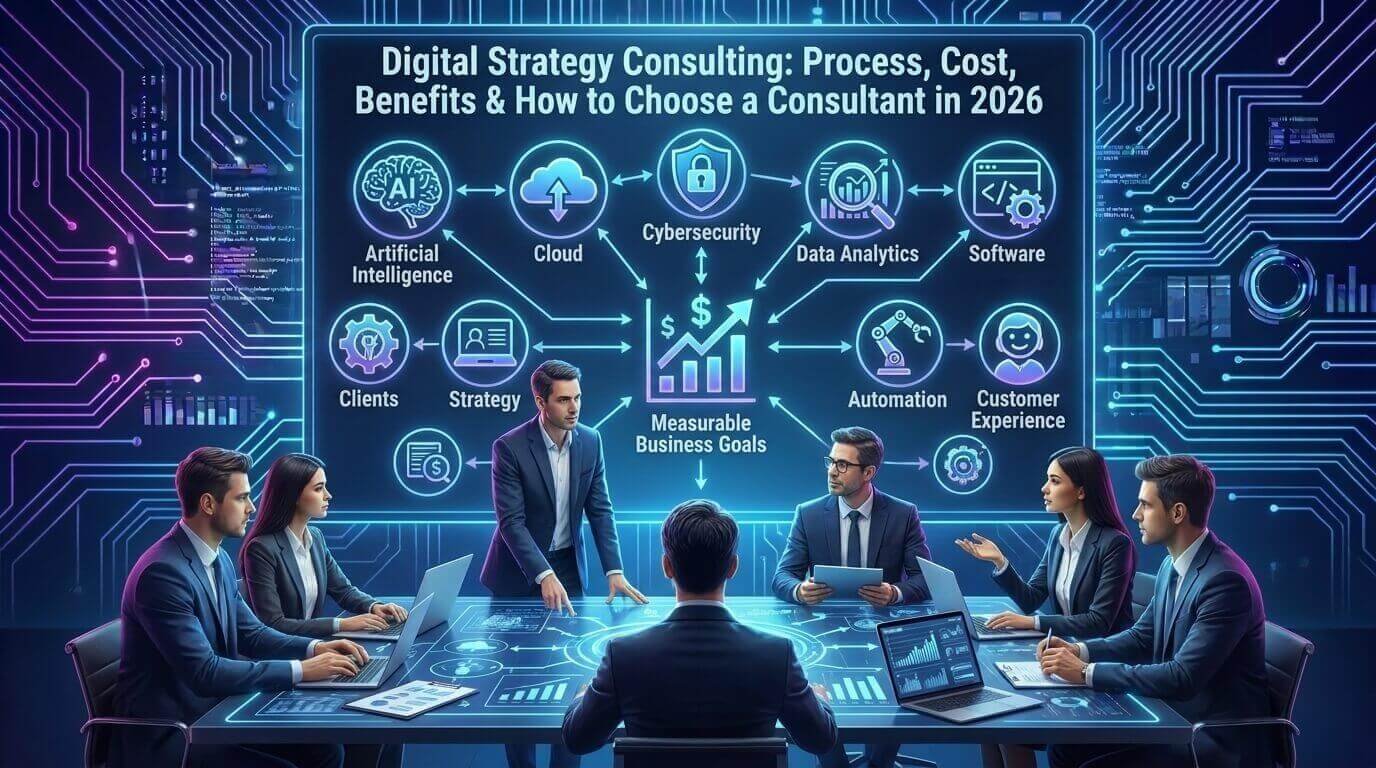
Digital strategy consulting connects business objectives with technology, data, software, digital channels, and emerging technologies. A consultant typically assesses the current digital environment, identifies gaps and opportunities, prioritizes initiatives, develops a roadmap, and helps define how success should be measured.
This guide explains what digital strategy consulting involves, what a consultant actually delivers, how the process works, what affects consulting costs, how AI is changing the field, and how to choose a consulting partner.
What Is Digital Strategy Consulting?
Digital strategy consulting helps a business decide how to use technology and digital capabilities to achieve specific business goals. A consultant evaluates existing systems and processes, identifies opportunities, prioritizes investments, creates a digital roadmap, and establishes measurable outcomes. The focus is not on adopting more technology but on choosing technology that addresses meaningful business needs.
What Is Digital Strategy Consulting?
Digital strategy consulting sits between business strategy and technology strategy.
A business might already have a website, CRM, cloud services, analytics platforms, automation tools, and AI applications. That does not necessarily mean those technologies work together effectively.
For example, a retailer could have thousands of website visitors but poor online sales. Buying another marketing tool might seem like an obvious solution, but the real problem could be:
- A difficult mobile checkout
- Poor product navigation
- Fragmented customer data
- Weak analytics
- Slow website performance
- Poor CRM integration
- An ineffective customer journey
A digital strategy consultant looks at the broader picture before recommending a solution.
The goal is to answer questions such as:
- What business problem are we trying to solve?
- What digital capabilities do we already have?
- Where are the biggest gaps?
- Which opportunities have the greatest potential business value?
- What should we do first?
- What will each initiative require?
- How will we measure the result?
This broader approach is consistent with how digital technology and business consulting increasingly connects information, technology, and business strategy. Gartner describes the market as involving interconnected initiatives rather than isolated technology layers.
What Does a Digital Strategy Consultant Do?
A digital strategy consultant helps an organization understand its current position, determine where it wants to go, and decide how technology can help it get there.
The exact responsibilities depend on the project, but they commonly include the following.
Assess Digital Maturity
A digital maturity assessment looks at how effectively a business uses digital capabilities.
It can cover:
- Technology systems
- Software
- Data and analytics
- Digital customer experiences
- Internal processes
- Cloud infrastructure
- Cybersecurity
- AI capabilities
- Employee skills
- Digital governance
The assessment helps identify strengths, weaknesses, dependencies, and areas that need attention.
Identify Business and Technology Gaps
A company may have good technology but poor processes. Another may have useful data but limited analytics capabilities.
Common gaps include:
- Disconnected software
- Legacy systems
- Duplicate data
- Manual processes
- Poor reporting
- Weak digital customer experiences
- Limited automation
- Security weaknesses
- Lack of AI governance
Identifying the gap is important because a technology purchase should address a real problem rather than create another layer of complexity.
Prioritize Digital Initiatives
Businesses rarely have unlimited budgets, people, or time.
A consultant can help prioritize projects according to factors such as:
| Factor | Question |
|---|---|
| Business impact | What could this initiative improve? |
| Cost | What investment is required? |
| Complexity | How difficult is implementation? |
| Risk | What could go wrong? |
| Time to value | How quickly could benefits appear? |
| Strategic fit | Does it support the company’s objectives? |
| Dependencies | What needs to happen first? |
This turns a long list of technology ideas into a manageable set of priorities.
Build a Digital Roadmap
A digital roadmap translates strategy into a sequence of actions.
For example:
Phase 1: Improve website performance and analytics
Phase 2: Connect CRM and marketing systems
Phase 3: Automate repetitive workflows
Phase 4: Introduce selected AI use cases
Phase 5: Expand data and analytics capabilities
The roadmap should reflect the organization’s actual budget, skills, systems, and capacity rather than simply listing every possible technology project.
What Services Are Included in Digital Strategy Consulting?
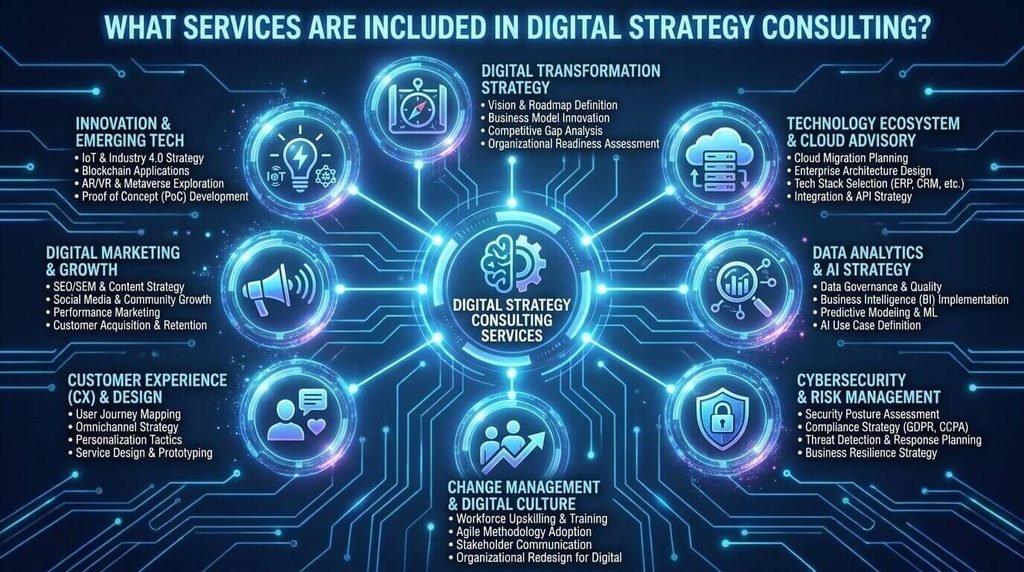
Digital consulting services vary between providers, but common areas include the following.
Digital Maturity Assessment
An assessment of the organization’s current digital capabilities, processes, technology, data, and customer experience.
Digital Transformation Strategy
A broader strategy for changing how an organization operates through technology, processes, people, data, and digital experiences.
Technology Strategy
A technology strategy helps determine:
- Which systems should remain
- Which systems should be upgraded
- Which should be replaced
- Where integration is needed
- Whether cloud adoption makes sense
- Whether custom software is justified
- Which technologies deserve priority
Data and Analytics Strategy
Data strategy can address:
- Data quality
- Data governance
- Data integration
- Reporting
- Business intelligence
- Analytics
- Data security
- AI readiness
Current strategy guidance increasingly emphasizes connecting data and AI investments to measurable business outcomes rather than treating them as isolated technology projects.
AI Strategy
An AI strategy identifies where AI could realistically create value and what the organization needs to deploy it responsibly.
Possible areas include:
- Generative AI
- AI agents
- Customer service automation
- Predictive analytics
- Document processing
- Software development
- Knowledge management
- Workflow automation
An effective AI strategy should also consider:
- Data quality
- Security
- Privacy
- Governance
- Human oversight
- Integration
- Cost
- Expected business value
Customer Experience Strategy
Digital strategy can also focus on how customers interact with a business across:
- Websites
- Mobile applications
- E-commerce
- Customer portals
- Self-service
- CRM
- Digital support
- Personalized experiences
Cloud and Application Strategy
Cloud strategy is not simply about moving everything to the cloud.
It involves evaluating infrastructure, applications, security, cost, scalability, operating models, and business requirements.
For some organizations, modernization or selective cloud adoption may make more sense than moving every system immediately. IBM’s strategy consulting services similarly cover technology investments, AI, data, automation, and hybrid cloud strategy.
How Does Digital Strategy Consulting Work?
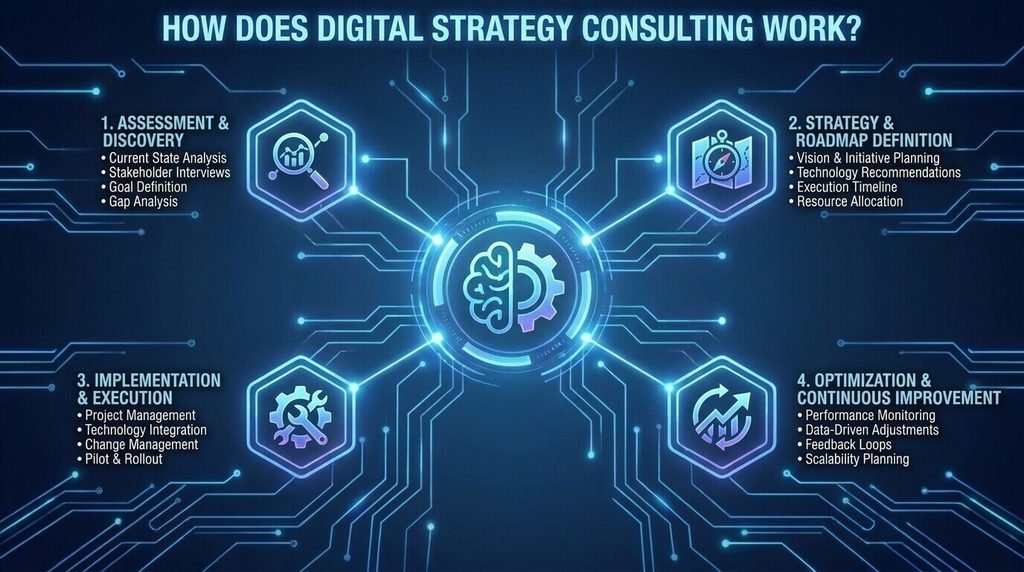
A practical digital strategy framework usually follows a sequence like this.
1. Define the Business Objectives
Start with the business problem, not the technology.
Examples:
- Increase online sales
- Reduce operating costs
- Improve customer retention
- Automate manual work
- Improve reporting
- Launch a digital product
- Modernize outdated systems
- Prepare for AI adoption
2. Assess the Current State
Review existing:
- Technology
- Software
- Processes
- Data
- Digital channels
- Customer experiences
- Skills
- Security controls
This creates a baseline for the strategy.
3. Analyze Customers and Competitors
Look at customer expectations, digital journeys, market conditions, and relevant competitor capabilities.
A company does not necessarily need to copy competitors. The purpose is to understand the environment in which its strategy will operate.
4. Identify Gaps and Opportunities
Compare the current state with the desired future state.
This might reveal opportunities in:
- Automation
- AI
- Cloud
- Software modernization
- Analytics
- Customer experience
- Cybersecurity
- CRM
- Website development
5. Generate and Evaluate Initiatives
Potential projects should be assessed against business value, cost, complexity, risk, and strategic fit.
6. Prioritize the Portfolio
Not every worthwhile idea belongs in the first phase.
Prioritization helps answer:
What should we do now, next, later, or not at all?
7. Create the Digital Roadmap
The roadmap should show:
- Initiatives
- Timing
- Dependencies
- Resources
- Investment requirements
- Responsible teams
- Expected outcomes
8. Build the Business Case
For significant projects, estimate:
- Initial investment
- Ongoing costs
- Expected benefits
- Risks
- Required skills
- Implementation time
The goal is not to promise a guaranteed return. It is to make assumptions visible so decision-makers can evaluate them.
9. Define KPIs
Each major initiative should have measurable objectives.
For example, an automation project could measure processing time, error rates, labor hours, and cost per transaction.
10. Implement, Measure, and Adjust
Strategy should not end with a PDF or presentation.
As projects progress, organizations should compare actual results with the original assumptions and adjust priorities when necessary.
Gartner’s current consulting research describes digital strategy work around areas such as digital maturity, technology transformation, business transformation, and outcome-focused consulting capabilities.
What Does a Digital Strategy Consultant Deliver?
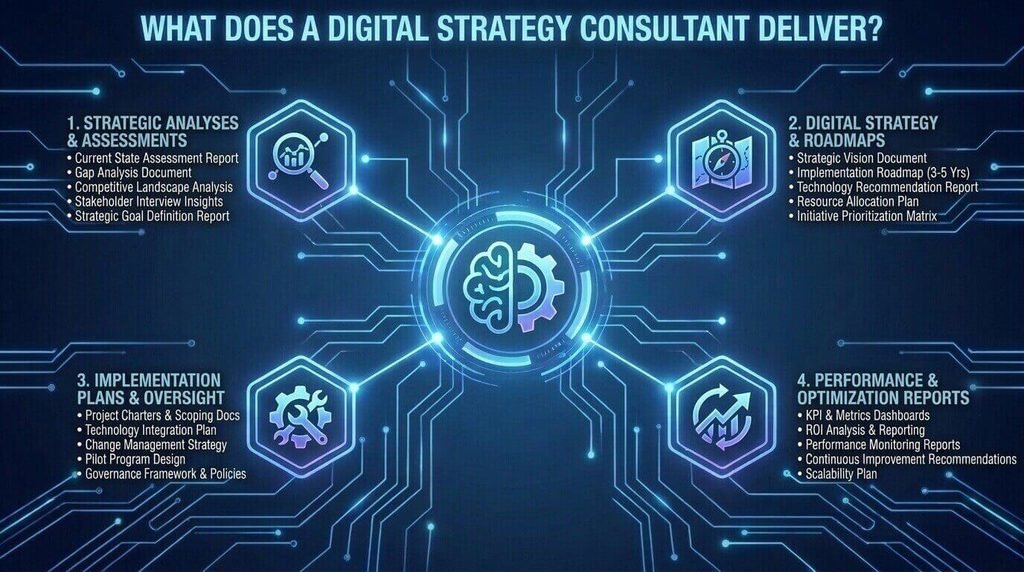
The final deliverables depend on the engagement, but a project may include:
| Deliverable | What it provides |
|---|---|
| Digital maturity assessment | A view of current capabilities |
| Technology assessment | Analysis of existing systems and gaps |
| Customer journey map | Visibility into customer pain points |
| Competitive analysis | Context for market positioning |
| Digital strategy | Strategic direction and priorities |
| Digital roadmap | Sequence and timing of initiatives |
| Business case | Investment and expected-value analysis |
| KPI framework | Measurement criteria |
| AI opportunity assessment | Potential AI use cases |
| Implementation plan | Practical steps for execution |
This distinction matters when comparing consulting proposals. Two providers can both advertise “digital strategy consulting” while offering very different deliverables.
Digital Strategy vs. Digital Transformation vs. IT Consulting
These terms overlap, but they describe different areas of work.
| Area | Digital Strategy Consulting | Digital Transformation | IT Consulting |
|---|---|---|---|
| Main focus | Direction and priorities | Broader organizational change | Technology systems |
| Main question | What should we do? | How should we change? | How should the technology work? |
| Typical output | Strategy and roadmap | Transformation program | Technical recommendations |
| Business involvement | High | Very high | Varies |
| Implementation | Sometimes | Often | Often |
| Typical scope | Strategic | Organization-wide | Technology-focused |
A company may use all three at different stages. For example, digital strategy could define priorities, transformation could manage the organizational change, and IT consulting could address specific technical implementation challenges.
When Does a Business Need Digital Strategy Consulting?
A business may want strategic guidance when technology decisions have become difficult to coordinate.
Potential signs include:
- Multiple disconnected systems
- Unclear technology priorities
- Large upcoming technology investments
- Repeatedly delayed digital projects
- Fragmented customer data
- Too many manual workflows
- Outdated software
- Poor digital customer experiences
- Unclear AI opportunities
- Difficulty measuring digital project results
- Need for a long-term technology roadmap
When You May Not Need a Consultant
Consulting is not automatically necessary for every technology project.
For example, a small business that needs a straightforward informational website may only need a web development professional.
Likewise, a company with a well-defined technical specification may need implementation support rather than strategic consulting.
Consulting tends to become more relevant when the problem is broad, the investment is significant, several systems are involved, or leadership needs help deciding between competing priorities.
How Much Does Digital Strategy Consulting Cost?
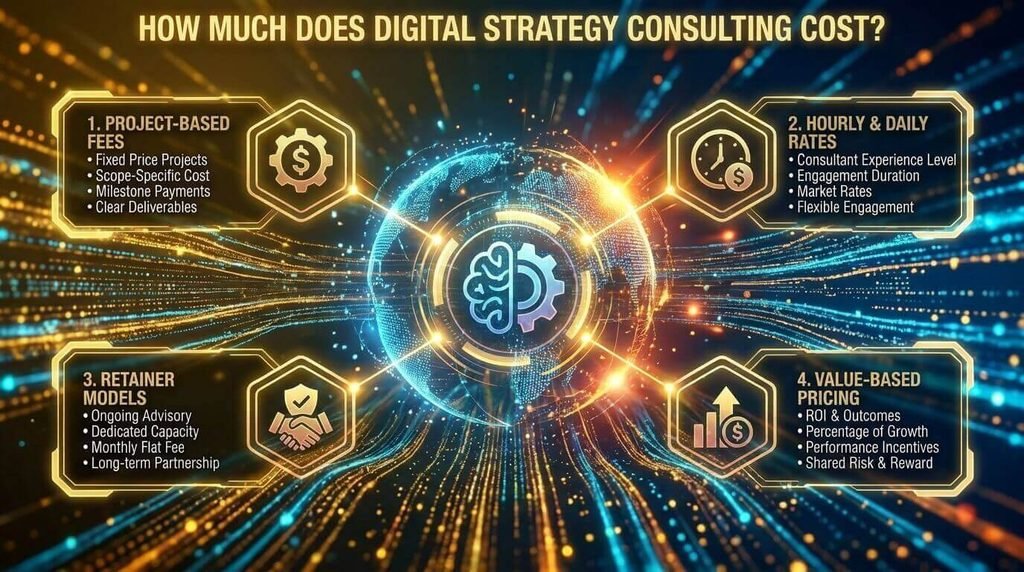
There is no universal price for digital strategy consulting.
The cost depends heavily on the scope, complexity, organization size, number of systems involved, and level of implementation support required.
Common pricing approaches include:
- Hourly consulting
- Fixed-fee strategy projects
- Retainer arrangements
- Assessment engagements
- Larger transformation programs
What Affects the Cost?
Important factors include:
Business size: Larger organizations often have more systems, stakeholders, and processes to assess.
Project scope: A focused digital maturity assessment is different from a multi-year transformation strategy.
Technology complexity: Legacy systems, integrations, cloud environments, and custom applications can increase the work involved.
Data requirements: Large or fragmented data environments may require additional analysis.
AI requirements: AI strategy can involve use-case assessment, governance, data readiness, security, and implementation planning.
Implementation support: Strategy-only work generally differs from engagements that continue into implementation.
For website-related initiatives, it is also useful to understand the factors that influence website development cost, particularly when a digital roadmap includes a new website, redesign, integrations, or custom functionality.
Instead of comparing consulting proposals only by price, compare the scope and deliverables.
Ask:
- What will be assessed?
- What will be delivered?
- Who will perform the work?
- How many workshops or interviews are included?
- Is implementation support included?
- How will success be measured?
- What costs are excluded?
How Do You Measure the ROI of Digital Strategy Consulting?
The value of consulting should ultimately connect to business outcomes.
Potential KPIs include:
- Revenue
- Conversion rate
- Customer acquisition cost
- Customer retention
- Operating costs
- Employee productivity
- Processing time
- Automation rate
- Customer satisfaction
- Digital adoption
- Time-to-market
- System utilization
Example: Automating Invoice Processing
Suppose a company wants to automate invoice processing.
Simply saying “the company implemented automation” does not demonstrate value.
A better measurement framework compares:
| Before | After |
|---|---|
| Manual processing time | Automated processing time |
| Number of errors | Error rate |
| Staff hours required | Staff hours saved |
| Cost per invoice | New cost per invoice |
| Processing backlog | Remaining backlog |
This turns a technology project into a measurable business initiative.
How Is AI Changing Digital Strategy Consulting in 2026?
AI is changing both the technology landscape and the questions businesses need to answer.
Instead of asking only:
“Which AI tool should we buy?”
business leaders increasingly need to ask:
“Which business problems should AI solve, what data and processes are required, and how will we measure the result?”
Current industry research describes AI, data, automation, cloud, and digital transformation as increasingly interconnected areas of technology and business strategy.
Common AI Strategy Areas
A digital strategy may examine opportunities involving:
- Generative AI
- AI agents
- Predictive analytics
- Customer service
- Document processing
- Knowledge management
- Software development
- Marketing automation
- Workflow automation
- Forecasting
AI Strategy Also Requires Risk Planning
A realistic AI strategy should consider:
- Data privacy
- Security
- Governance
- Accuracy
- Human oversight
- Model limitations
- Integration
- Ongoing costs
AI should therefore be evaluated as part of the organization’s operating model and business strategy, not simply as a new software purchase.
Digital Strategy Consulting Examples
The following are illustrative examples, not claims about specific consulting clients.
Example 1: E-Commerce Business
An online retailer has increasing traffic but declining conversions.
An assessment finds:
- A difficult mobile checkout
- Weak product filtering
- Fragmented customer data
- Limited analytics
- No automated abandoned-cart workflow
A possible roadmap could prioritize:
- Mobile checkout improvements
- Better analytics
- CRM integration
- Customer segmentation
- Marketing automation
Relevant KPIs could include conversion rate, cart abandonment, average order value, and repeat purchases.
Example 2: Small Professional Services Business
A consulting company receives leads through email, phone, social media, and its website.
Employees manually transfer lead information into spreadsheets.
A digital strategy could identify opportunities for:
- CRM implementation
- Website lead forms
- Automated lead routing
- Calendar integration
- Email workflows
- Analytics
The objective is not to introduce complex technology. It is to reduce manual work and create a more consistent lead-management process.
Example 3: Manufacturing Company
A manufacturer experiences unexpected equipment downtime.
A strategy assessment may identify opportunities involving:
- IoT sensors
- Equipment monitoring
- Data analytics
- Predictive maintenance
- Automated alerts
Before investing, the company should evaluate expected downtime reduction, implementation cost, maintenance requirements, and the availability of reliable equipment data.
How to Choose a Digital Strategy Consultant
Choosing a consultant should involve more than comparing service pages.
1. Look for Relevant Experience
Industry experience can be useful because different industries have different processes, regulations, customers, and technology environments.
2. Ask About the Methodology
A consultant should be able to explain how the engagement moves from:
Assessment → Analysis → Prioritization → Roadmap → Implementation → Measurement
3. Review Relevant Case Studies
Look for specific descriptions of:
- The business problem
- The approach
- Technologies involved
- Deliverables
- Outcomes
Be cautious with vague claims that cannot be substantiated.
4. Check Technology Capabilities
Depending on the project, relevant expertise could include:
- AI
- Cloud
- Data analytics
- Software development
- Cybersecurity
- Automation
- CRM
- Web development
5. Clarify Deliverables
Ask exactly what you will receive at the end of the engagement.
6. Understand the Pricing Model
Clarify what’s included, what isn’t, and how additional work is charged.
7. Ask How Success Will Be Measured
A strategy should connect recommendations to business objectives and measurable outcomes.
8. Consider Implementation Support
A strategy may be easier to execute when the consulting team can help translate recommendations into practical initiatives, although the appropriate level of support depends on the organization.
Common Digital Strategy Consulting Mistakes
Starting With Technology Instead of the Problem
Buying software before defining the business requirement can lead to unnecessary complexity.
Start with the desired business outcome.
Trying to Transform Everything at Once
A roadmap with dozens of simultaneous projects may overwhelm teams and budgets.
Prioritization matters.
Ignoring Existing Technology
Before buying another platform, determine whether existing systems can solve the problem through configuration, integration, or process changes.
Ignoring Data Quality
Poor-quality data can undermine analytics, automation, personalization, and AI projects.
Failing to Define KPIs
Without measurable objectives, it becomes difficult to determine whether an initiative worked.
Forgetting Employees
Digital transformation changes workflows and responsibilities. Training, communication, and adoption need to be considered alongside technology.
Treating AI as a Standalone Project
AI often creates more value when connected to real business workflows, reliable data, appropriate governance, and human oversight.
Ignoring Cybersecurity
New applications, integrations, cloud services, and AI systems can introduce additional security and privacy considerations.
Creating a Roadmap Nobody Can Implement
A roadmap should account for:
- Budget
- People
- Skills
- Dependencies
- Technical constraints
- Change management
- Implementation capacity
When a roadmap includes custom software, development planning should also account for requirements, design, development, testing, deployment, and maintenance. A related TechDigitalNet resource on the software development life cycle covers these stages in more detail.
Practical Tips for Building a Digital Strategy
You do not necessarily need a massive transformation program to improve your digital strategy.
Start With One Business Problem
Choose a specific problem that can be measured.
Audit What You Already Have
Review existing software, data, websites, integrations, infrastructure, and processes before buying something new.
Prioritize by Value and Feasibility
A technically impressive project is not automatically the right first project.
Consider both potential impact and the organization’s ability to execute.
Connect Technology to Customers
Ask how each major digital initiative affects the customer journey, employee experience, revenue, cost, or risk.
Make Data Part of the Strategy
Reliable data is foundational for analytics, automation, personalization, and many AI use cases.
Include Security From the Start
Security and privacy should be considered during planning rather than added after deployment.
Measure Before and After
Create a baseline before launching a major initiative so the eventual result can be evaluated.
Review the Roadmap Regularly
A digital strategy should evolve as technology, customers, competitors, regulations, and business priorities change.
Frequently Asked Questions
What is digital strategy consulting?
Digital strategy consulting helps businesses determine how technology, software, data, AI, and digital channels can support their business objectives. Consultants assess current capabilities, identify gaps, prioritize initiatives, develop roadmaps, and establish ways to measure progress.
What does a digital strategy consultant do?
A digital strategy consultant evaluates an organization’s technology, processes, data, digital experiences, and business goals. They then identify opportunities, prioritize initiatives, develop recommendations, and create a practical roadmap for implementation.
How much does digital strategy consulting cost?
There is no standard price. Cost depends on project scope, organization size, technology complexity, data requirements, geographic scope, and whether the engagement includes implementation support.
What is the difference between digital strategy and digital transformation?
Digital strategy defines priorities and explains how digital capabilities can support business objectives. Digital transformation is the broader process of changing technology, processes, people, and operating models to achieve those objectives.
When should a business hire a digital strategy consultant?
Consulting may be useful when a company has unclear technology priorities, disconnected systems, outdated infrastructure, major technology investments, fragmented data, or uncertainty about AI, cloud, automation, or digital transformation.
Does every business need digital strategy consulting?
No. A clearly defined technical project may only require a developer, software specialist, or IT consultant. Strategic consulting becomes more relevant when the problem spans multiple systems, departments, investments, or business objectives.
How do you measure digital strategy success?
Use business-specific KPIs such as revenue, conversion rate, customer retention, operating costs, productivity, automation, customer satisfaction, time-to-market, or digital adoption.
How is AI changing digital strategy?
AI is expanding digital strategy into areas such as workflow redesign, automation, data readiness, governance, security, and operating-model changes. Businesses increasingly need to evaluate AI according to measurable business value rather than adoption alone.
Conclusion
Digital strategy consulting is about making technology decisions that support real business objectives.
The goal is not to adopt every new AI tool, cloud platform, software product, or digital trend. It is to understand the business problem, assess the current environment, identify meaningful opportunities, prioritize investments, and create a roadmap the organization can realistically execute.
For one company, the right strategy might involve improving its website and CRM. For another, it could involve cloud modernization, software development, automation, cybersecurity, data analytics, or AI.
The most useful starting point is simple:
Define the business problem first. Then determine which digital capabilities can solve it.
From there, assess your current systems, prioritize opportunities, define measurable KPIs, estimate investment, and build a roadmap that matches your organization’s resources and goals.
That is the practical role of digital strategy consulting: turning technology decisions into a clear, measurable plan for digital business improvement.